
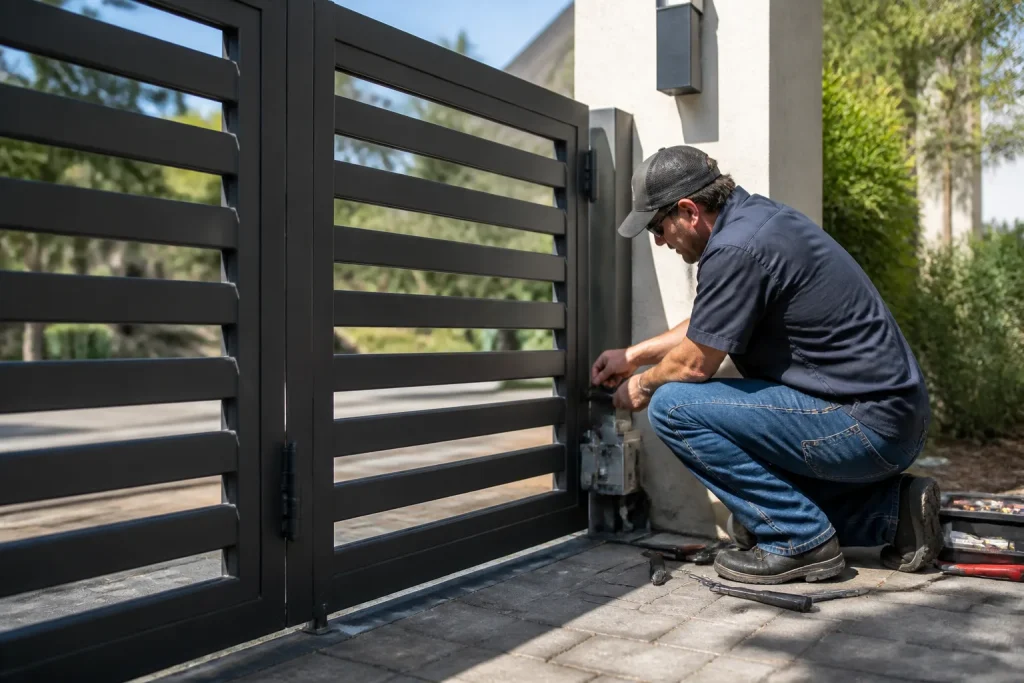
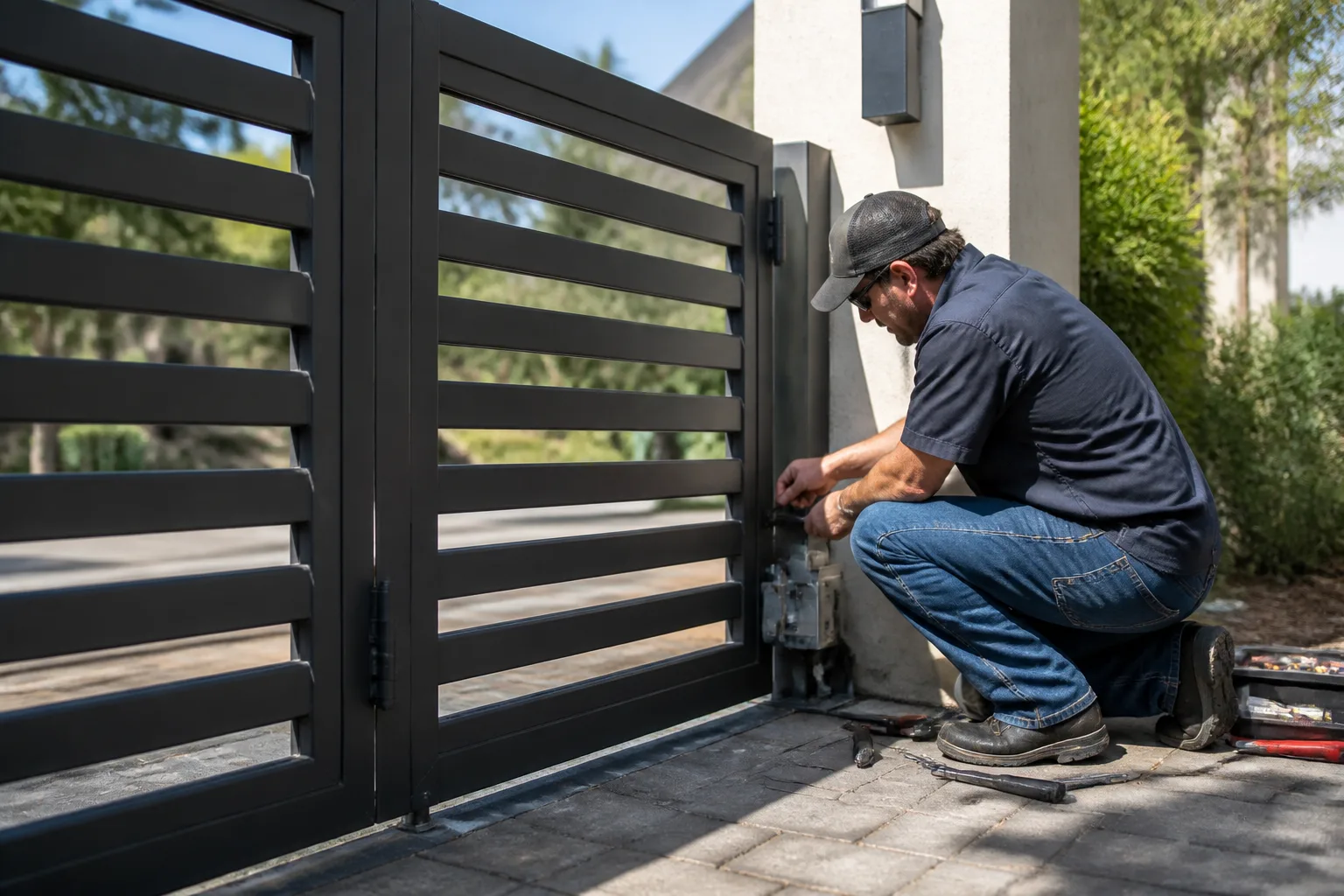
Gate Repair: Repair or Replace? How Los Angeles Homeowners Decide
Most Los Angeles homeowners assume a gate’s age determines whether to repair or replace it. It doesn’t. A 20-year-old gate with a solid steel frame and a corroded operator is a repair job. A 6-year-old gate with a warped post and a perfect motor is often a replacement. The real decision hinges on two independent systems, not one calendar. If you’d rather skip the diagnosis and get a straight answer on your specific gate, call us at (833) 805-4890 for a free estimate.
The Two-System Framework Every Gate Owner Should Know
After 14 years of exclusively gate work across Los Angeles, we’ve learned to split every gate into two systems that age on completely different timelines.
Structural system: frame, posts, hinges, track, wheels, and welds. This is the skeleton. It faces rain, sun, soil movement, and the occasional fender bender.
Mechanical system: operator, control board, sensors, wiring, remote receivers, and access control. This is the nervous system. It faces power surges, moisture infiltration, and obsolescence.
These two systems rarely fail simultaneously. That’s why age is misleading. We’ve replaced three-year-old operators bolted to thirty-year-old frames that will outlive the house. We’ve also torn out eight-year-old aluminum gates in Brentwood where the posts had settled so badly from clay soil expansion that the track was twisted beyond saving.
Here’s the diagnostic order we use on every job:
- Check structural integrity first. A failed frame makes any motor investment temporary.
- If the frame is sound, price the mechanical repair against replacement cost.
- If both systems show fatigue, replacement is usually the only economic path.
In Los Angeles, where replacement costs run higher than national averages due to permitting and hillside access, getting this sequence wrong costs thousands.
The 60 Percent Rule: When Repair Becomes Bad Math
Experienced gate techs use a simple ratio. When the repair estimate exceeds 60 percent of a full replacement, replacement wins. Not because the repair won’t work, but because you’re investing heavily in a system with depleted remaining life.
Here’s how this plays out in Los Angeles pricing:
| Scenario | Repair Estimate | Replacement Estimate | Verdict |
|---|---|---|---|
| Operator failure, solid frame | $850–$1,400 | $3,200–$5,500 | Repair |
| Post rot/settling, good operator | $1,800–$3,000 | $3,500–$6,000 | Replace (operator won’t survive re-install) |
| Board + sensor + hinge failure | $1,600–$2,400 | $3,800–$5,200 | Replace (cascading failures signal systemic wear) |
| Single component (arm, remote, photo eye) | $200–$600 | $3,500+ | Repair, obviously |
The hidden cost homeowners miss is labor duplication. If we replace your operator today and your frame fails in eighteen months, you pay for operator removal and re-installation all over again. We’ve seen this exact sequence in Pacific Palisades, where salt air accelerates both corrosion and the temptation to band-aid.
Why Sacramento’s Ground Movement Changes the Math
Wait, Sacramento? Yes. We handle enough cross-referral work and see enough parallel conditions that the comparison matters. Sacramento’s clay-heavy soil and seasonal moisture swings cause post heaving and settlement that Los Angeles homeowners rarely anticipate.
Here’s what happens: a gate installed in 2019 looks fine above ground. Below grade, the concrete footing has cracked from soil expansion. The post tilts 3 degrees. The track binds. The operator strains, drawing excess amperage, burning out the board.
The homeowner sees a motor failure and assumes operator replacement. We see a structural root cause that will destroy the new motor in two years. In these cases, the 60 percent rule doesn’t apply because repair isn’t actually possible without addressing the footing. That’s replacement territory, and it’s more common in areas with expansive soil than most people realize.
Los Angeles has its own version of this. Hillside properties in the Hollywood Hills or Laurel Canyon deal with drainage-driven erosion around footings. The symptom looks mechanical. The disease is structural.
The Insurance and Liability Angle Most People Ignore
A gate with a failed structural component is a liability exposure that a working operator cannot fix. This is where emotional attachment gets expensive.
We’ve had Los Angeles homeowners insist on repairing gates with cracked welds at the hinge because “it still opens fine.” Here’s the problem: when that weld separates and the gate swings into a pedestrian or vehicle, your homeowner’s policy will examine maintenance records. A known structural defect that was patched rather than resolved becomes evidence of negligence.
The same applies to automatic gates with failed safety sensors. If the operator works but the entrapment protection doesn’t, you’re operating an unguarded machine. California property code is specific about automatic gate safety. Liability for injury on a known-defective gate falls hard on the owner.
Our recommendation: if a structural failure creates injury risk, replacement isn’t optional. It’s risk management. The operator working perfectly is irrelevant if the frame or safety system is compromised.
When Sentiment Is Rational, and When It’s Costing You
We’ve pulled ornate iron gates out of Hancock Park estates where the owner nearly teared up watching us load them. Those gates were hand-forged, matched the 1920s architecture, and couldn’t be replicated at any price. Keeping them made sense. We repaired the frames, upgraded the operators to modern DoorKing systems, and preserved something genuinely irreplaceable.
We’ve also had owners in Studio City cling to a generic aluminum slider from 2014 because “it matches the house.” It doesn’t. It’s a mass-produced beige extrusion. The repair estimate was $2,100. Replacement was $3,400. They chose repair. Eighteen months later, a different component failed. Total spent: $3,900. They could have had a new gate with a warranty.
The honest test: would a buyer notice and value this gate? If yes, repair may be justified. If no, run the numbers coldly.
When to Call a Pro
If your gate is binding, making new noises, reversing unexpectedly, or showing visible rust at welds or post bases, get a structural-mechanical split diagnosis before authorizing any work. A generalist will quote what they know how to fix. A gate-only specialist will tell you which system is actually failing.
Related services in Los Angeles: Ironwood Gate Repair Los Angeles home for full diagnostic and repair, or our Gate Repair in Sacramento page if you’re managing properties up north.
Key Takeaways
- Age alone is a poor decision factor. Separate structural from mechanical condition.
- Apply the 60 percent rule: repair above this threshold of replacement cost is usually poor economics.
- Los Angeles hillside properties and areas with clay soil require deeper structural scrutiny.
- Insurance and liability exposure from known structural defects can make replacement mandatory, not optional.
- Emotional attachment is valid only when the gate is genuinely irreplaceable, not merely familiar.
The Bottom Line
The repair-or-replace decision rewards patience and punishes haste. We’ve seen Los Angeles homeowners save thousands by correctly diagnosing a simple operator failure, and we’ve seen others pour money into gates that needed honest retirement. The difference is always the same: looking at the two systems independently, pricing the true repair, and measuring against replacement without sentiment.
If you’re in Los Angeles and staring at a gate that’s not behaving, Ironwood Gate Repair Los Angeles offers free on-site estimates. David and his team will give you the structural-mechanical split, the 60 percent math, and a straight recommendation. Call (833) 805-4890 or book online. No charge if you decide to wait, and no pressure either way.
Frequently Asked Questions
Structural issues show as visible movement: sagging, binding, post lean, or weld cracks. Mechanical issues show as electrical behavior: motor hums but doesn’t move, remote intermittent, safety sensors misaligned, or control board clicking. If the gate physically can’t roll or swing smoothly when disconnected from the operator, the problem is structural. If it moves freely by hand but not by remote, it’s mechanical. Call (833) 805-4890 and we’ll diagnose which system is failing at no charge.
Repair is cheaper when a single component in an otherwise sound system fails. Replacement becomes cheaper when multiple components are failing, when structural damage exists, or when the repair exceeds 60 percent of replacement cost. In Los Angeles, where labor and access costs run high, this threshold is reached faster than in lower-cost markets. Get an exact quote for both before deciding.
Yes, if the frame and track are sound. We regularly install modern operators on existing gates, including compatibility with brands like Viking, Ghost Controls, and Elite. The catch: the old gate must be square, level, and free of binding. A new operator on a warped frame will strain, fail early, and void warranty. We check frame integrity first. If it’s good, an operator upgrade is a cost-effective refresh.
A well-built iron or steel gate frame should last 25–40 years with maintenance. Aluminum gates last 15–25 years. Operators last 10–15 years depending on cycle count and brand. The critical variable is installation quality and soil stability, not just material. We’ve seen ten-year-old gates fail from poor drainage around footings, and forty-year-old gates soldier on with good maintenance. Call for a condition assessment if you’re unsure where yours stands.
Written by David Kaplan, Owner / Field Supervisor at Ironwood Gate Repair Los Angeles, serving Los Angeles since 2012.
Need Gate Repair Help?
Call Ironwood Gate Repair Los Angeles — licensed & insured, here with fast after-hours help in Los Angeles.
(833) 805-4890