FAAC Gate Repair in Los Angeles: A Homeowner’s Guide
FAAC gate repair in Los Angeles typically costs between $280 and $650 for most residential issues, with same-day service available for common failures like encoder errors or hydraulic fluid leaks. FAAC operators are Italian-engineered commercial-grade systems that outlast most American brands, but their diagnostic language and failure patterns are different enough that technicians fluent in LiftMaster or Linear often misdiagnose them. If you’re staring at a blinking red light and a gate that won’t budge, you can call us at (833) 805-4890 for a free estimate — no obligation, and we’ll walk you through whether it’s a quick fix or something that needs parts.
Here’s the thing most Los Angeles homeowners don’t realize until they’ve already wasted money: FAAC operators don’t fail the way American brands fail. A tech who diagnoses a FAAC 415 hydraulic swing gate the same way they’d diagnose a LiftMaster CSW200 will get it wrong half the time. We’ve been called out to homes in Brentwood and Silver Lake where a previous company replaced a perfectly good control board when the real problem was a $12 thermal relief valve, or condemned a motor that just needed its encoder recalibrated. After 14 years of gate-only work and 233 verified reviews, we’ve learned that FAAC fluency isn’t something you pick up from a manual — it’s field-earned.
How FAAC Operators Are Built Differently
FAAC makes two distinct families of gate operators, and knowing which one you own changes everything about how it’s diagnosed and repaired.
Hydraulic operators — the 400-series swing gates and 800-series slides — use a sealed fluid circuit to move the gate. A small electric motor runs a hydraulic pump, which pressurizes oil to push a piston. These are brutally reliable for heavy gates, but they introduce failure modes that don’t exist in electromechanical systems: thermal expansion of fluid in the Sacramento summer heat (yes, we see this constantly even in Los Angeles-adjacent climates), seal degradation from UV exposure, and cavitation from low fluid levels after slow leaks.
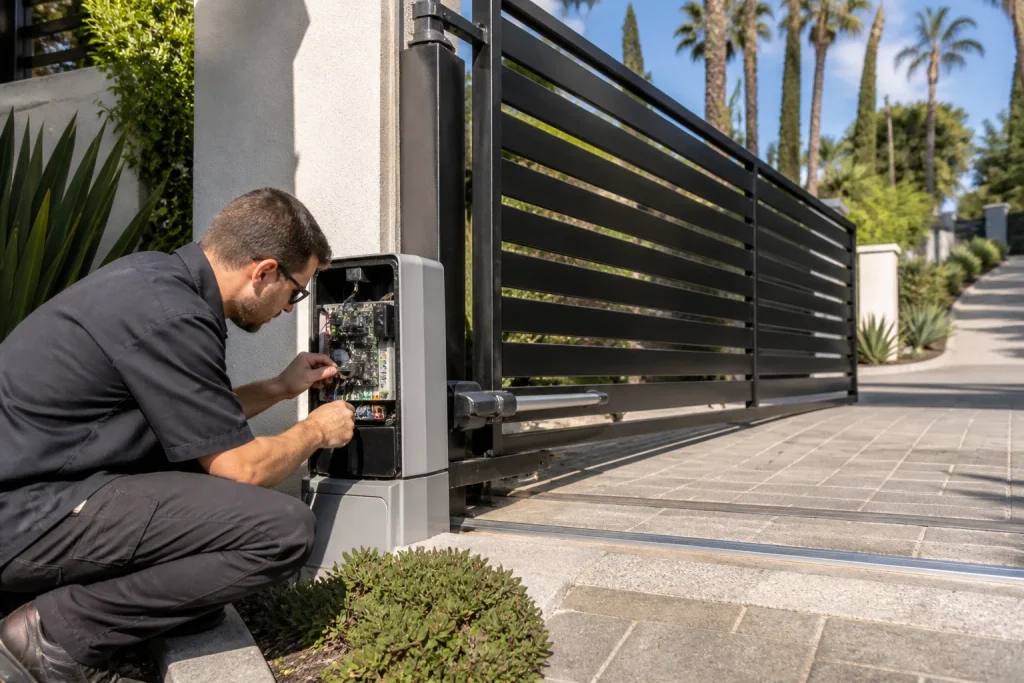
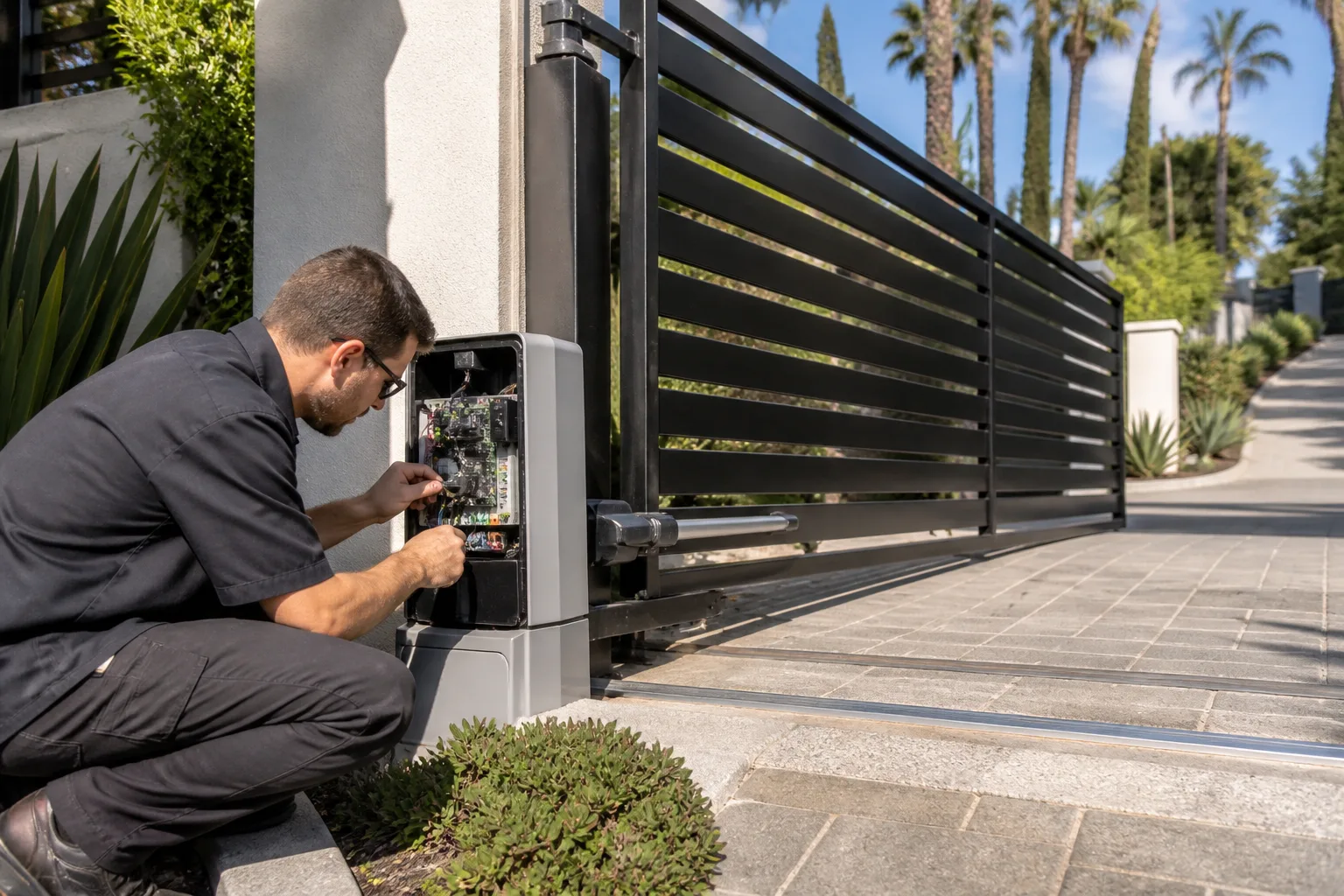
Electromechanical operators — like the 740 and S800 series — use direct-drive motors with gear reduction. They’re simpler in theory, but FAAC’s encoder-based position sensing and soft-start algorithms are more sophisticated than most American equivalents. When an encoder fails, the gate doesn’t just “stop working” — it often behaves erratically, reversing mid-cycle or refusing to close fully, which techs misread as a limit switch problem.
In our experience across Los Angeles, from the hills of Pacific Palisades to the flat lots of Van Nuys, hydraulic FAAC units outlast electromechanical ones by 3-5 years on average — but only if the fluid system is maintained. Most homeowners don’t even know their operator has hydraulic fluid until it starts weeping onto the driveway.
Reading Your FAAC’s Blink Codes: The One DIY Step Worth Doing
Before you call anyone, check the LED on your FAAC control board. It’s the small red light near the terminal strip, and it’s telling you exactly what’s wrong — if you know the language.
Here’s what we’ve decoded from thousands of calls in Los Angeles:
- 1 blink, pause, repeat: Safety device interruption — photocell, loop detector, or edge sensor is open. Check for spider webs across the photo eye (happens constantly in the canyons) or a vehicle parked on the induction loop.
- 2 blinks: Motor overcurrent. Gate is physically obstructed, or the motor is failing. Don’t keep cycling it — you’ll cook the windings.
- 3 blinks: Encoder fault (electromechanical models). The system has lost position reference. Sometimes recoverable with a reset, often needs encoder replacement.
- 4 blinks: Thermal shutdown. Common in July and August when hydraulic fluid overheats or motor ventilation is blocked by dust.
- 5 blinks: Control board memory error. This is where generic techs panic-replace the board. Often it’s just corrupted parameters from a power surge, and factory restoration fixes it.
- Steady red (no blinking): Fatal board or power supply failure. Time for professional diagnosis.
We pulled one out of a garage over in Los Feliz last month where the homeowner had watched 3 blinks for two weeks, cycled the breaker obsessively, and finally called us when the gate started reversing into his Tesla. The encoder had been degrading gradually — classic FAAC behavior — and a $180 part plus 20 minutes of calibration fixed what another company had quoted as a $1,400 “full motor replacement.”
Why FAAC Parameter Restoration Matters After Any Board Work
This is the single most expensive mistake we see in Los Angeles FAAC repairs.
When a FAAC control board is replaced — or even when some “resets” are performed — the factory default parameters don’t match your specific gate. FAAC operators store dozens of variables: gate travel distance, deceleration curves, obstacle sensitivity, pedestrian mode timing, and safety device logic. A generic reset wipes these to Italian factory defaults, which assume a 3-meter steel gate on level ground, not your 16-foot aluminum cantilever on a 4% grade in the Hollywood Hills.
We’ve arrived at jobs in Encino and Studio City where a previous technician had replaced the board, confirmed the gate “worked,” and left — but the gate now slammed closed hard enough to damage the stop post, or opened only halfway, or ignored the safety edge entirely. The board wasn’t defective. The parameters weren’t restored.
Proper FAAC parameter restoration requires:
- Measuring actual gate travel with the system in manual mode
- Setting soft-start and soft-stop ramps appropriate to gate weight and wind load
- Calibrating obstacle detection sensitivity for the specific gate type (aluminum gates need different settings than wrought iron)
- Verifying safety device logic matches local install — normally open vs. normally closed contacts
- Testing all modes: auto-close, pedestrian, partial open, manual release
This takes 30-45 minutes when done right. Techs who aren’t FAAC-fluent often skip it entirely, or don’t know the difference between a “reset” and a full parameter configuration. At Ironwood Gate Repair Los Angeles home, David and his team carry the FAAC programming cable and updated software on every truck — it’s not an afterthought.
Common FAAC Failures in Los Angeles: Heat, Dust, and Encoder Wear
Los Angeles isn’t the hottest climate we work in — that would be Gate Repair in Sacramento — but our specific combination of intense UV, Santa Ana wind cycles, and fine dust creates predictable failure patterns in FAAC operators.
Hydraulic thermal expansion: On days above 95°F, which we see 15-20 times yearly even near the coast, hydraulic fluid in 400-series operators expands beyond the reservoir capacity. The thermal relief valve is supposed to vent this safely, but when the valve itself degrades (common after 8+ years), fluid weeps past seals and the system loses pressure. The gate moves slowly, stalls mid-cycle, or fails to open entirely. The fix isn’t a new motor — it’s a $25 valve, fresh fluid, and seal inspection. We’ve saved Los Angeles homeowners thousands by knowing the difference.
Encoder failures on swing operators: FAAC’s magnetic encoders are precise but vulnerable to moisture intrusion and magnetic debris. After rain — rare but intense when it happens — we see a spike in encoder errors in canyon-adjacent neighborhoods like Topanga and Laurel Canyon. The encoder sends erratic position data, and the control board responds with confused, jerky movement. Replacement encoders are FAAC-specific and carry longer lead times than American-brand equivalents, which brings us to parts reality.
Parts lead times and why truck stock matters: FAAC is headquartered in Bologna, Italy, with North American distribution in Pennsylvania. Common wear items — seals, encoder modules, control boards for current models — typically ship in 3-5 business days. Older models (pre-2015 400-series, discontinued 750 electromechanical units) can stretch to 2-3 weeks. This is not a brand where you want a technician who has to “order it and come back.” Our trucks in Los Angeles carry FAAC-specific seals, encoders, thermal valves, and a programming interface because we’ve learned that “we’ll return next week” means a week without security.
When to Call a Pro vs. What You Can Check Yourself
You can safely check: power at the outlet, photocell alignment, manual release operation, and those LED blink codes. You can clear debris from the track and verify nothing’s physically blocking gate travel.
Don’t attempt: hydraulic fluid service (pressurized system, risk of injury and environmental contamination), control board parameter changes without documentation, or any work on the high-tension spring assist mechanisms found on some large FAAC swing gates. These springs store lethal energy and require proper winding tools.
If your FAAC is blinking 3, 4, or 5 times, if there’s visible hydraulic fluid, or if the gate has been “fixed” once already and the problem returned, it’s time for a specialist. Generic gate companies in Los Angeles often don’t stock FAAC parts or carry the programming tools. David Kaplan serves as Field Supervisor at Ironwood, which means the person with final accountability shows up — not a rotating subcontractor figuring it out on your dime.
Related services in Los Angeles: Gate Installation in Sacramento and Gate Motor & Opener in Sacramento for our northern California customers, or contact our Los Angeles team directly for local FAAC service.
The Bottom Line
FAAC operators are worth the repair investment — they’re engineered for 15-20 year lifespans when properly maintained, versus 8-12 for most residential-grade American brands. But that longevity depends on technicians who understand hydraulic circuits, encoder calibration, and Italian parameter logic, not just standard troubleshooting charts.
Key takeaways for Los Angeles FAAC owners:
- Learn your blink code before calling anyone — it’ll save you from misdiagnosis
- Hydraulic and electromechanical FAAC models fail completely differently; know which you own
- Any board replacement or “reset” demands full parameter restoration, not just a quick test
- Parts availability varies — truck stock separates same-day fixes from multi-week waits
- 14 years of gate-only experience and 233 verified reviews mean we’ve likely seen your exact failure before
If you’re in Los Angeles and your FAAC gate is acting up, call (833) 805-4890 for a free estimate. David and his team will diagnose it accurately the first time, stock the parts to finish the job, and program it to your specific gate — not factory defaults from Bologna.
Frequently Asked Questions
Most residential FAAC repairs in Los Angeles run between $280 and $650, including diagnosis, parts, and labor. Simple fixes like photocell alignment or parameter restoration start around $180-$220. Encoder replacements or hydraulic seal kits typically fall in the $340-$480 range. Full control board replacement with proper programming can reach $550-$850 depending on the model. Call (833) 805-4890 for an exact quote — estimates are free.
For FAAC operators under 12 years old, repair is almost always more economical — a $400 repair extends a system that originally cost $2,500-$4,000 installed. Replacement with comparable commercial-grade hardware runs $3,200-$5,500 in Los Angeles, including removal and new installation. We only recommend replacement when the operator has catastrophic structural failure, obsolete parts availability, or repeated failures indicating systemic wear. Call (833) 805-4890 and we’ll give you an honest assessment.
Yes, for most common failures. Our trucks stock FAAC-specific encoders, hydraulic seals, thermal valves, and control boards for current and recent models. Same-day completion rate in Los Angeles is roughly 85% for calls we take before 1 PM. The main exceptions are pre-2015 hydraulic units needing obsolete parts, or jobs requiring custom welding fabrication — those typically finish next business day. Call (833) 805-4890 to check same-day availability.
They likely weren’t fluent in the brand. FAAC uses proprietary programming interfaces, Italian-language parameter logic, and hydraulic systems that don’t appear in most American-brand training. A company that primarily installs LiftMaster or Mighty Mule may genuinely lack the tools and knowledge to service FAAC properly — and rather than admit it, some claim the system is “unsupported” or “obsolete.” We’ve serviced FAAC operators in Los Angeles that other companies condemned, simply because we carry the programming cable and understand the diagnostic language. If you’ve been told your FAAC can’t be fixed, get a second opinion — call (833) 805-4890.
Written by David Kaplan, Owner / Field Supervisor at Ironwood Gate Repair Los Angeles, serving Los Angeles since 2012.
Need Gate Repair Help?
Call Ironwood Gate Repair Los Angeles — licensed & insured, here with fast after-hours help in Los Angeles.
(833) 805-4890