
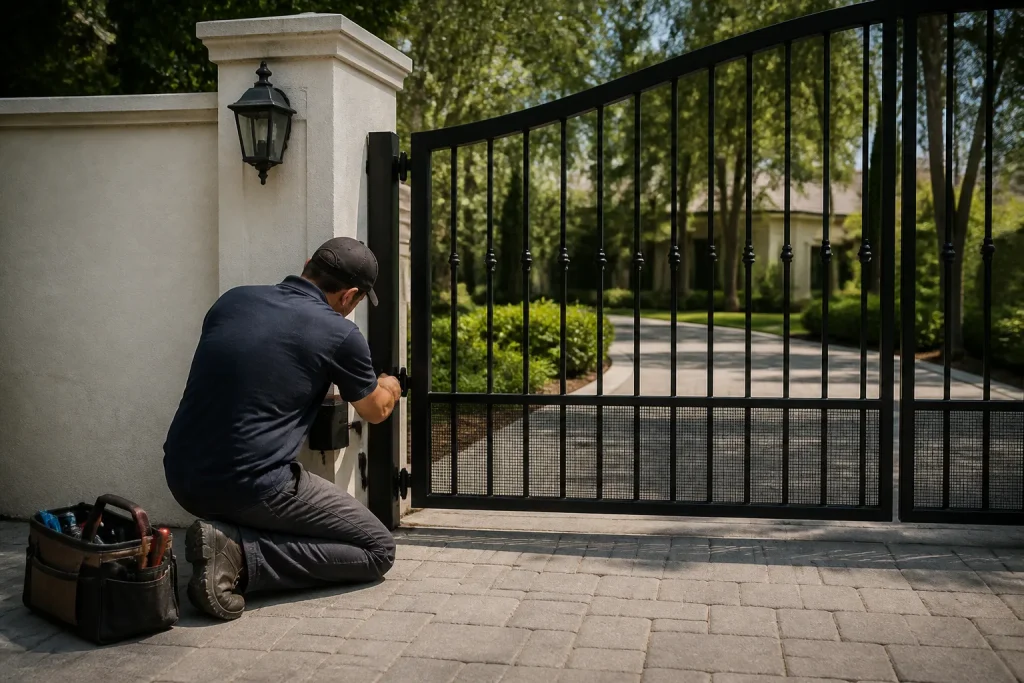
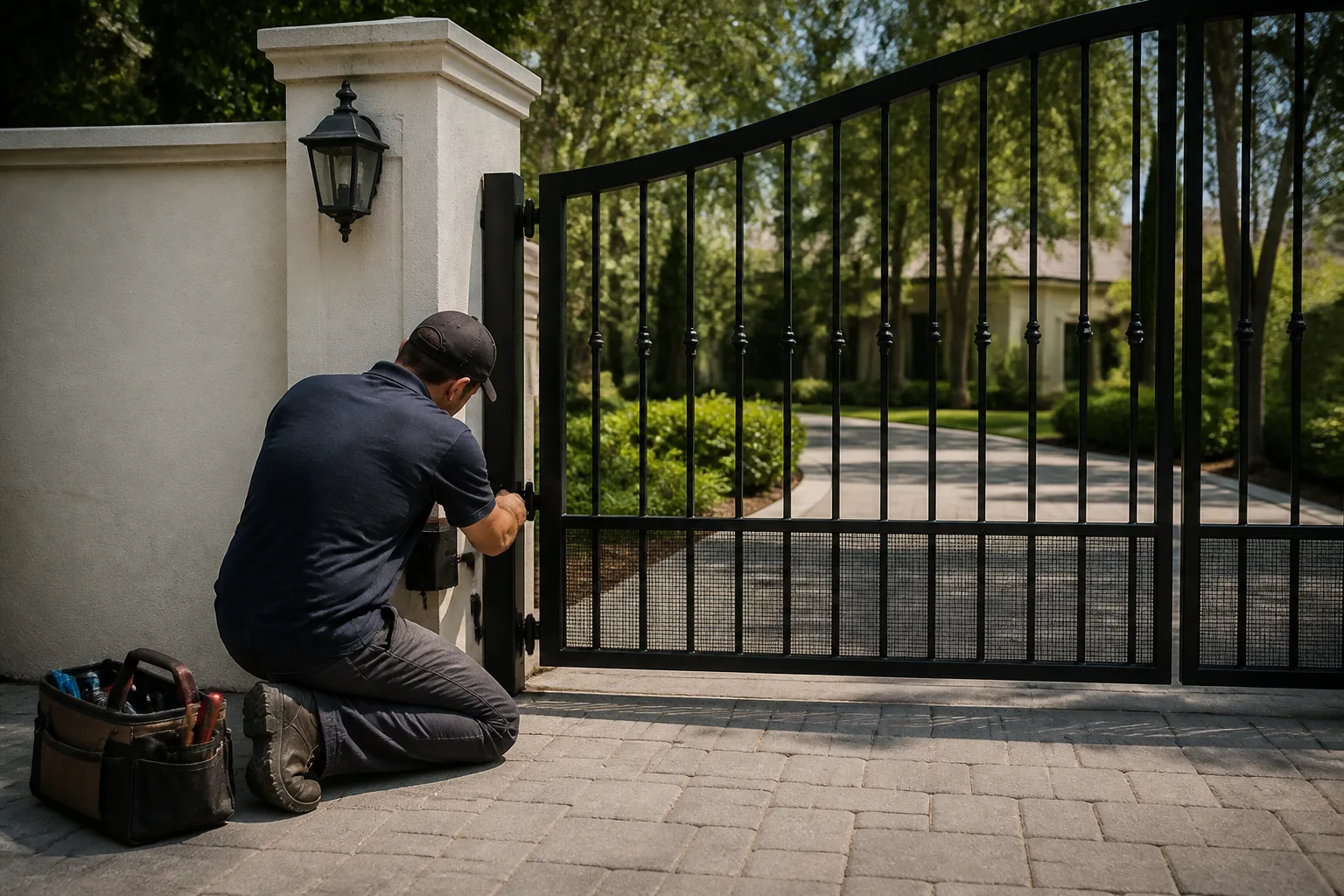
BFT Gate Repair in Los Angeles: A Homeowner’s Guide
BFT gate repair in Los Angeles typically runs $280–$620 depending on whether you’re dealing with a simple limit reset, a failed control board, or a full motor replacement. Most BFT issues in Southern California trace back to three root causes: heat-related thermal cutouts, encoder drift from vibration, or the programming step installers skip that causes phantom reversals six months later. If you’re staring at a blinking error code and don’t want to decode it yourself, call us at (833) 805-4890 — we carry BFT parts and can usually diagnose it on the first trip.
Why BFT Error Codes Actually Matter
Most technicians in Los Angeles look up BFT fault codes on their phones. We’ve memorized the diagnostic tree because BFT’s Italian engineering logic is actually a roadmap to the fix, not just a random number to Google.
Here’s what happens: a BFT operator flashes a code, and that code points to a specific subsystem. Code 1? Encoder pulse issue. Code 3? Thermal protection triggered. Code 4? Obstruction detection fault. The difference between a $180 service call and a $600 motor replacement often comes down to whether the person reading that code understands which subsystem is crying wolf and which one is actually broken.
We’ve pulled BFT units out of garages over in Encino last month where a previous company had replaced two motors in eighteen months. The motors weren’t failing. The encoder wheels were slipping on the output shaft during summer heat expansion, throwing false pulse errors, and each “tech” just kept swapping motors without checking the mechanical coupling. Fourteen years of gate-only work teaches you to trust the fault logic, not just throw parts at it.
The Heat Problem: Why Los Angeles Summers Kill BFT Operators
Southern California’s climate creates a specific failure mode that BFT owners in milder regions rarely see. BFT motors run thermal protection at 140°F internal temperature. In a Los Angeles July, with a steel gate box sitting in direct afternoon sun in Van Nuys or Northridge, that threshold hits faster than you’d expect.
But here’s what most miss: the thermal cutout is usually a symptom, not the disease. We see three actual root causes in our territory:
- Ventilation blocked by debris — palm fronds, dust from Santa Ana winds, or rodent nests choke the cooling fins
- Gate overload from hinge seizure — the motor works harder as hinges dry out, pushing current draw up 30–40%
- Incorrect duty cycle programming — the installer left the factory default for a lighter European gate, and your solid steel Los Angeles security gate exceeds the allowed cycles per hour
The fix isn’t always “bigger motor.” Often it’s freeing a hinge, cleaning the housing, and reprogramming the thermal model. We’ve saved Pacific Palisades homeowners full replacements by catching this pattern early.
Encoder Limits vs. Magnetic Limits: Why BFT Is Different
BFT uses optical encoder wheels to track gate position. Cheaper brands — and even some DoorKing or Elite units — rely on magnetic limit switches. The difference matters for diagnosis and for what breaks.
Magnetic limits are dumb. A magnet passes a reed switch, the board knows “I’m at the end.” Simple, but they drift with temperature and they can’t tell the board where the gate is mid-travel.
BFT’s encoder sends continuous pulse feedback. The control board knows exact position, speed, and acceleration at every millimeter. This is why BFT operators can do soft-stop deceleration, obstacle detection by current spike analysis, and precise partial-open commands.
It’s also why encoder failure looks like total system failure. When the encoder wheel cracks, slips on its shaft, or gets dust in the optical path, the board loses all position reference. The gate might slam, reverse randomly, or refuse to move entirely. We’ve had Santa Monica customers tell us “the motor’s dead” when it’s actually a $12 encoder wheel with a hairline crack from vibration.
Replacement encoders are brand-specific and model-specific. We stock the common BFT encoder assemblies because we’ve learned the hard way that waiting two weeks for Italian air freight doesn’t work when someone’s driveway is blocked.
Deimos, Virgo, or Phobos: Know Your Unit
BFT’s residential and light-commercial line has three workhorses, and the repair profile is different on each. Homeowners who know which they have get faster, more accurate service calls.
Deimos BT — The sliding gate standard. 500–800 kg capacity, worm-gear driven. Common in Los Angeles hillside homes with long driveway gates. The weak point is the bronze worm wheel under sustained load; we’ve replaced dozens where the gate was simply too heavy for the spec’d unit. The BT A version adds magnetic limit backup, which confuses diagnosis if the encoder and limits disagree.
Virgo — Articulated arm for swing gates with wide pillars. The joint bearings wear in coastal salt air — think Marina del Rey or Malibu — and the arm geometry drifts. A Virgo with sloppy joints will throw “obstruction” faults because the motor senses irregular resistance, not because anything’s blocking the gate.
Phobos BT — Linear actuator for swing gates, cleaner look than Virgo. The Achilles heel is the internal limit switch cam on early production; it cracks and lets the actuator over-travel, stripping the nylon drive nut. Later Phobos BT A models fixed this with metal cams, but you can’t visually tell without opening the housing.
We carry rebuild kits for all three. David and his team have replaced enough Phobos drive nuts to do it in under an hour now.
Parts Reality: What We Stock vs. What Ships from Italy
This is where BFT ownership in Los Angeles gets practical. Some components have North American distribution. Others don’t.
Typically stocked locally: Deimos and Phobos motors, standard control boards (Thalia, Alena), remote controls, photocells, basic encoder wheels, and safety edges. Most Los Angeles BFT dealers can get these within a few days.
Often import-only: Specialized gearboxes for high-cycle commercial units, older BFT control boards (the pre-2015 D board series), certain articulated arm castings for Virgo, and custom-length linear actuators for Phobos. Lead time: 2–4 weeks, sometimes longer if customs delays.
Our shop carries deeper BFT inventory than most because we’ve been the ones caught short. When a Hollywood Hills property manager has a tenant locked out at 6 PM on Friday, “it’s on a boat from Milan” isn’t an answer. We fabricate or adapt where we can — in-house welding and machining means we’re not waiting for a bracket that we can cut and drill ourselves.
If you’re planning a BFT installation or upgrade, ask your installer: “Which parts are stocked in California?” The honest answer tells you something about how fast future repairs will go.
The Programming Step Installers Skip
This one costs homeowners real money. BFT operators require a force-learning calibration after installation. The board measures actual gate resistance across the full travel, then sets internal thresholds for obstacle detection. Most installers in a hurry — or installers who don’t specialize in gates — skip this or do a rushed version.
Six months later, the gate starts reversing for no visible reason. Leaves on the track? No. Physical obstruction? No. The force thresholds were set with a new, freely-moving gate. Now hinges have settled, rollers have worn slightly, and the actual resistance has increased. The board thinks it’s hitting something.
We’ve fixed this exact pattern in Brentwood, Bel Air, and Los Feliz — always on systems installed by “full-service” companies that also do garage doors and alarms. The recalibration takes twenty minutes with the right programmer. The unnecessary service calls before finding us often cost $200–400 in repeat trips.
BFT’s U-Link software and older BFT A programming units both handle this. We carry both. It’s a small thing that separates gate-only specialists from dabblers.
When to Call a Pro
You can clear some BFT faults yourself — power cycle the board, check photocell alignment, remove obvious track debris. But stop before you open the motor housing or adjust limit settings manually. BFT’s encoder system can lose its reference entirely if you force-travel the gate with power off, and recovering that requires factory tools.
Call (833) 805-4890 if you’re seeing repeated thermal faults, random reversals, or any error code that returns after a power cycle. We diagnose BFT systems across Los Angeles same-day in most cases.
Related services in Los Angeles: Ironwood Gate Repair Los Angeles home | Gate Repair in Sacramento | Gate Installation in Sacramento | Gate Motor & Opener in Sacramento
Key Takeaways
- BFT error codes are diagnostic tools, not random numbers — they point to specific subsystems
- Los Angeles heat causes thermal cutouts, but the root cause is usually ventilation, hinge drag, or programming
- Encoder-based limits give precise control but fail differently than magnetic systems
- Deimos, Virgo, and Phobos each have known weak points that a specialist recognizes immediately
- Some BFT parts are California-stocked; others face 2–4 week import delays — plan accordingly
- The force-learning calibration skipped at installation causes phantom reversals six months later
The Bottom Line
BFT builds capable operators, but they reward owners who understand the system’s logic. Fourteen years of gate-only work in Los Angeles has taught us that most “unfixable” BFT problems trace back to misdiagnosis, skipped calibration, or parts nobody bothered to stock locally. If you’re in Los Angeles and your BFT gate is flashing codes, reversing randomly, or quitting in afternoon heat, Ironwood Gate Repair Los Angeles offers free estimates — call (833) 805-4890. David Kaplan handles field supervision personally, and we carry the parts to finish the job in one trip.
Frequently Asked Questions
Most BFT repairs in Los Angeles fall between $280 and $620. A simple encoder wheel replacement or force recalibration runs at the lower end. Control board replacement or full motor swap pushes toward the higher end. We don’t charge diagnostic fees if you proceed with the repair. Call (833) 805-4890 for an exact quote — estimates are free.
This pattern almost always means thermal cutout. The motor hits its internal temperature limit after heating through the day, especially in direct sun. The real fix isn’t replacing the motor — it’s finding why it’s overheating: blocked ventilation, dragging hinges, or incorrect duty-cycle programming for your gate’s weight. We’ve resolved this exact pattern across the San Fernando Valley without replacing hardware.
General handymen and garage door companies often struggle with BFT’s encoder logic and Italian control boards. We’ve been called to fix jobs where two previous companies swapped parts without diagnosing the actual fault. BFT’s diagnostic language rewards focused experience — we’ve worked on enough of them to read the fault tree without looking it up.
With proper installation and maintenance, 10–15 years is typical. The killer is usually neglect: dry hinges forcing the motor to overwork, never-cleaned housings trapping heat, or skipped recalibration letting the board overcurrent itself. We’ve seen 8-year-old BFT units fail prematurely and 18-year-old units still running strong — the difference is almost always installation quality and follow-up care.
Written by David Kaplan, Owner / Field Supervisor at Ironwood Gate Repair Los Angeles, serving Los Angeles since 2012.
Need Gate Repair Help?
Call Ironwood Gate Repair Los Angeles — licensed & insured, here with fast after-hours help in Los Angeles.
(833) 805-4890