
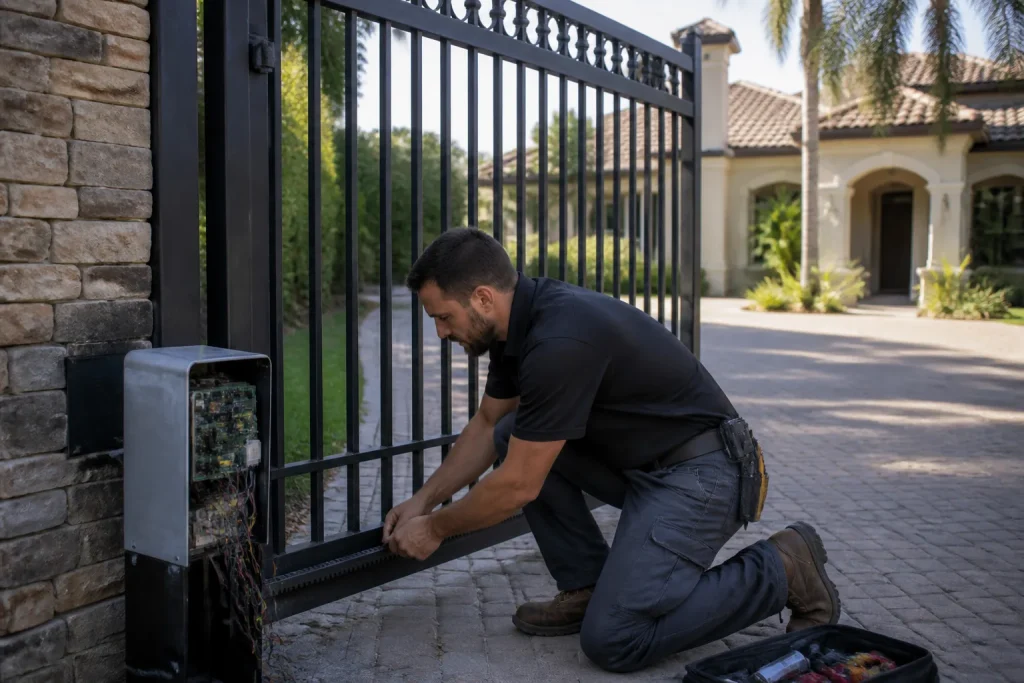
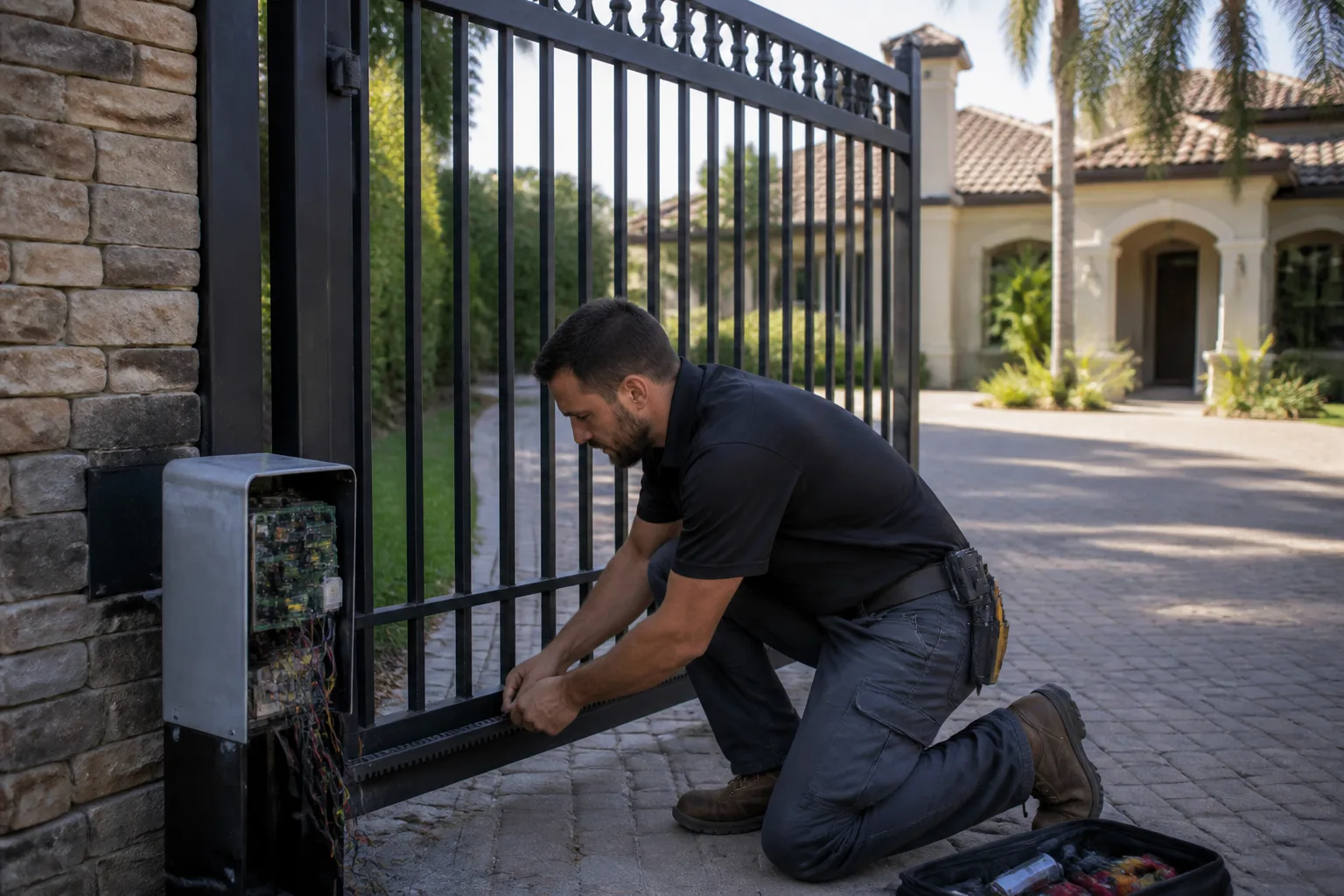
5 Mistakes to Avoid With Gate Installation
The five costliest gate installation mistakes are all buried underground or hidden inside the structure by the time you notice them: undersized posts set in shallow concrete, automation applied to a gate that doesn’t swing freely, missing UL 325 safety compliance, low-voltage and line voltage sharing conduit, and zero commissioning documentation. Every one of these is preventable if you verify five things before the first shovel hits dirt. If you’re planning a gate installation in Los Angeles and want it done right the first time, call us at (833) 805-4890 for a free estimate.
Here’s the mistake that costs the most to fix, and it’s not even the most dramatic one: running underground conduit without a pull wire. We’ve seen this over in Woodland Hills, where a homeowner called us three years after their original install because the motor kept losing communication with the keypad. The low-voltage wire had degraded, which happens. But the original installer hadn’t left a pull wire in the conduit. What should’ve been a 20-minute wire pull became a full trenching job through mature landscaping. The gate had to come off the hinges. Concrete had to be cut. That single omission turned a $200 repair into a $3,800 rebuild.
That’s the pattern with installation errors. They’re invisible until they’re catastrophic. After 14 years and 233 verified reviews, we’ve learned which five mistakes keep showing up on jobs we’re called to fix.
Mistake 1: Undersized Posts or Insufficient Concrete Depth
A gate post isn’t just a fence post with ambition. An automated gate in Los Angeles — especially a dual-swing system on a sloped driveway in the Hollywood Hills — generates lateral, torsional, and impact loads that multiply dramatically once a motor starts pushing.
Here’s the math that matters. A 16-foot single swing gate weighing 400 pounds creates a cantilever load at the post base. Add a LiftMaster or FAAC operator applying 200+ pounds of force to start that gate moving, and your post is now resisting a lever arm working against it constantly. We regularly pull out 4-inch posts set 24 inches deep in 80-pound bags of concrete. They’re leaning within two years. The motor strains. The gate drags. The electronics fail prematurely because they’re compensating for a structural problem.
Our standard for a residential automated gate in Los Angeles soil conditions: 6-inch minimum schedule 40 steel post, 36 inches deep, in 400+ pounds of concrete with rebar cage. For dual-swing systems or anything over 500 pounds, we step up to 8-inch posts with engineered footings. The motor can’t overcome physics. Neither can we. But we can spec the right foundation from day one.
Mistake 2: Automating a Gate That Doesn’t Swing Freely by Hand
This one hurts because it’s so easy to check. Before any operator goes on, the gate should swing through its full arc with one finger. One. Finger.
We’ve diagnosed this exact failure in Mid-Wilshire, where a newly installed gate was burning through Mighty Mule operators every 18 months. The homeowner assumed the motors were junk. What we found: the gate was binding on a slightly twisted frame, probably from the original welding. The operator was fighting that friction every cycle, overheating the motor, stripping nylon gears, and eventually failing completely. Three operators in three years, all because nobody checked manual operation first.
Automation amplifies problems. It doesn’t solve them. A gate that needs 15 pounds of force to move manually will demand 40+ pounds from the motor once you add wind load, hinge wear, and seasonal settling. The operator’s duty cycle rating assumes a properly balanced gate. Violate that assumption and you’re buying motors on a subscription plan.
Our process: install the gate, hang it, adjust hinges, verify level and plumb, then swing it by hand twenty times. Only then do we mount the operator and program limits.
Mistake 3: Skipping UL 325 Entrapment Protection
UL 325 isn’t a commercial-only requirement, and treating it like one is a legal exposure most Los Angeles homeowners don’t know they’re carrying.
The standard mandates photoelectric eyes, edge sensors, or equivalent entrapment protection on all automated gates, residential included. It also requires specific force limitation — a gate must reverse when it encounters 40 pounds of resistance. Here’s what that means in practice: if your gate hits a child, a pet, or a delivery driver and you’ve got no safety devices and no force testing record, you’re not just facing a civil suit. Your homeowner’s insurance can deny coverage for willful noncompliance with a recognized safety standard.
We’ve been called to properties in Pacific Palisades where the original installer — a general contractor, not a gate specialist — ran power to a motor and called it done. No photo eyes. No edge sensor. No control board configured for safety inputs. The gate worked until it didn’t, and “didn’t” meant contact with a vehicle. The homeowner assumed they were covered. They weren’t.
Every Ironwood Gate Repair Los Angeles installation includes UL 325-compliant devices, force testing with a certified gauge, and written documentation. Not because we’re cautious, but because we’ve seen what happens when this gets skipped.
Mistake 4: Low-Voltage and Line Voltage in the Same Conduit
This mistake creates the most frustrating failures: intermittent, unrepeatable, seemingly possessed. Gate opens fine nine times, then ignores the keypad. Or the intercom crackles with 60-cycle hum. Or the loop detector phantom-triggers at 2 AM.
The National Electrical Code is clear. Low-voltage control wiring (typically 24V AC/DC for gate operators, 12V for accessories) cannot share conduit with line voltage (120V/240V) without proper separation. The magnetic field from AC power induces noise in low-voltage circuits. Over runs longer than 50 feet — common in Los Angeles hillside properties where the house and gate are separated by driveway — this interference becomes operationally destructive.
Worse, mixed conduit fails inspection. If you’re pulling permits in Los Angeles County, the inspector will red-tag this every time. Then you’re cutting concrete to add separate runs.
We separate by default. Line voltage gets its own conduit with pull wire. Low-voltage gets its own. Where they must cross, we maintain 12 inches of horizontal separation and use shielded cable for sensitive communication runs. The BFT and DoorKing systems we install have specific grounding requirements that become impossible to meet when conductors are bundled together haphazardly.
Mistake 5: No Commissioning Documentation
This is the mistake you don’t know you need until you do. Commissioning documentation is the signed, dated record of how your gate was configured at installation: limit switch positions, force test readings, safety device function verification, and sensor response times.
Without it, you have no baseline. When the gate starts behaving differently in year three, everyone guesses. The motor’s working harder — is it wear, or was it always this way? The safety edge seems slow — did it degrade, or was it never right? We’ve walked onto jobs in Los Feliz where three different companies had “adjusted” the same operator over five years, each working from their own assumptions because no original settings existed.
More critically, documentation is liability protection. If your gate injures someone and there’s no record of proper force limitation and safety testing, you can’t prove the installation met standards. The absence becomes evidence against you.
Our commissioning packet includes: force test readings at multiple points in the gate arc, photo eye alignment verification with measured beam interruption response, edge sensor trigger and recovery timing, limit position photographs, and operator programming backup. David keeps copies. You keep copies. When something changes, we know what changed from.
When to Call a Pro
If you’re in the planning phase for a new gate in Los Angeles, the time to involve a specialist is before the concrete truck arrives. Post and footing specs, conduit routing, and safety device placement all get locked in during rough construction. Changing them later means demolition.
Related services in Los Angeles: Gate Repair in Sacramento for existing system diagnostics, or Gate Installation in Sacramento if you’re comparing options for new construction.
The Bottom Line
Gate installation mistakes are expensive precisely because they’re structural and buried. The five we’ve covered — posts, manual operation verification, UL 325 compliance, separated conduit, and commissioning documentation — share one trait: they’re all trivial to get right the first time and punishing to fix later.
Key takeaways:
- Spec posts and footings for automated loads, not manual gate loads
- Verify free-swinging manual operation before adding any operator
- Install and document UL 325 entrapment protection on every automated gate
- Keep low-voltage and line voltage in separate conduit runs
- Demand signed commissioning records with force readings and safety test results
If you’re in Los Angeles and want a gate installed by people who’ve spent 14 years learning what not to do, call Ironwood Gate Repair Los Angeles at (833) 805-4890. David handles the field supervision personally, and estimates are free.
Frequently Asked Questions
For automated gates in Los Angeles, 36 inches minimum in 400+ pounds of concrete with rebar reinforcement for 6-inch steel posts. Deeper and heavier for dual-swing systems or gates over 500 pounds. Call (833) 805-4890 and we’ll spec it for your exact gate and soil conditions.
Only if the gate swings freely through its full arc with minimal finger pressure. If it binds, sags, or needs force to move, automation will destroy motors until the underlying mechanical problem is fixed. We check this first on every conversion job in Los Angeles.
UL 325 applies to all automated gates, residential and commercial. While enforcement varies, liability for injury does not. If someone is hurt and you can’t prove compliant installation, your exposure is significant. We install photo eyes or edge sensors on every job and document the testing.
The most common cause we’ve found in Los Angeles is low-voltage interference from line voltage run in shared conduit. Other culprits: failing power supply, loose terminal connections, or safety devices with dirty lenses. We diagnose the actual cause rather than replacing parts randomly. Call (833) 805-4890 for troubleshooting — estimates are free.
Written by David Kaplan, Owner / Field Supervisor at Ironwood Gate Repair Los Angeles, serving Los Angeles since 2012.
Need Gate Repair Help?
Call Ironwood Gate Repair Los Angeles — licensed & insured, here with fast after-hours help in Los Angeles.
(833) 805-4890