
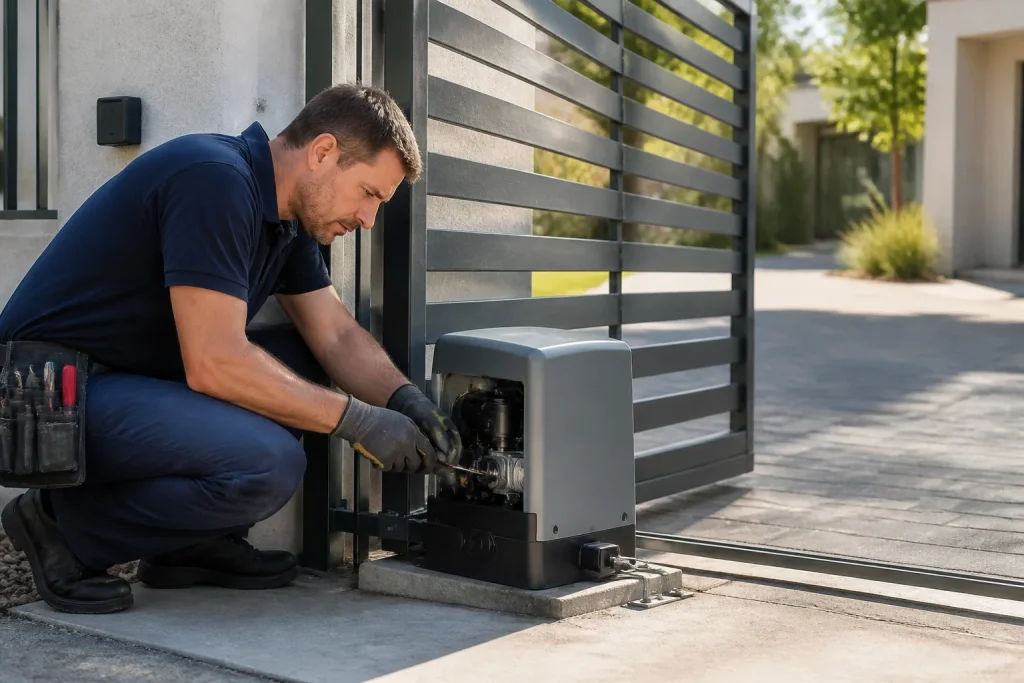
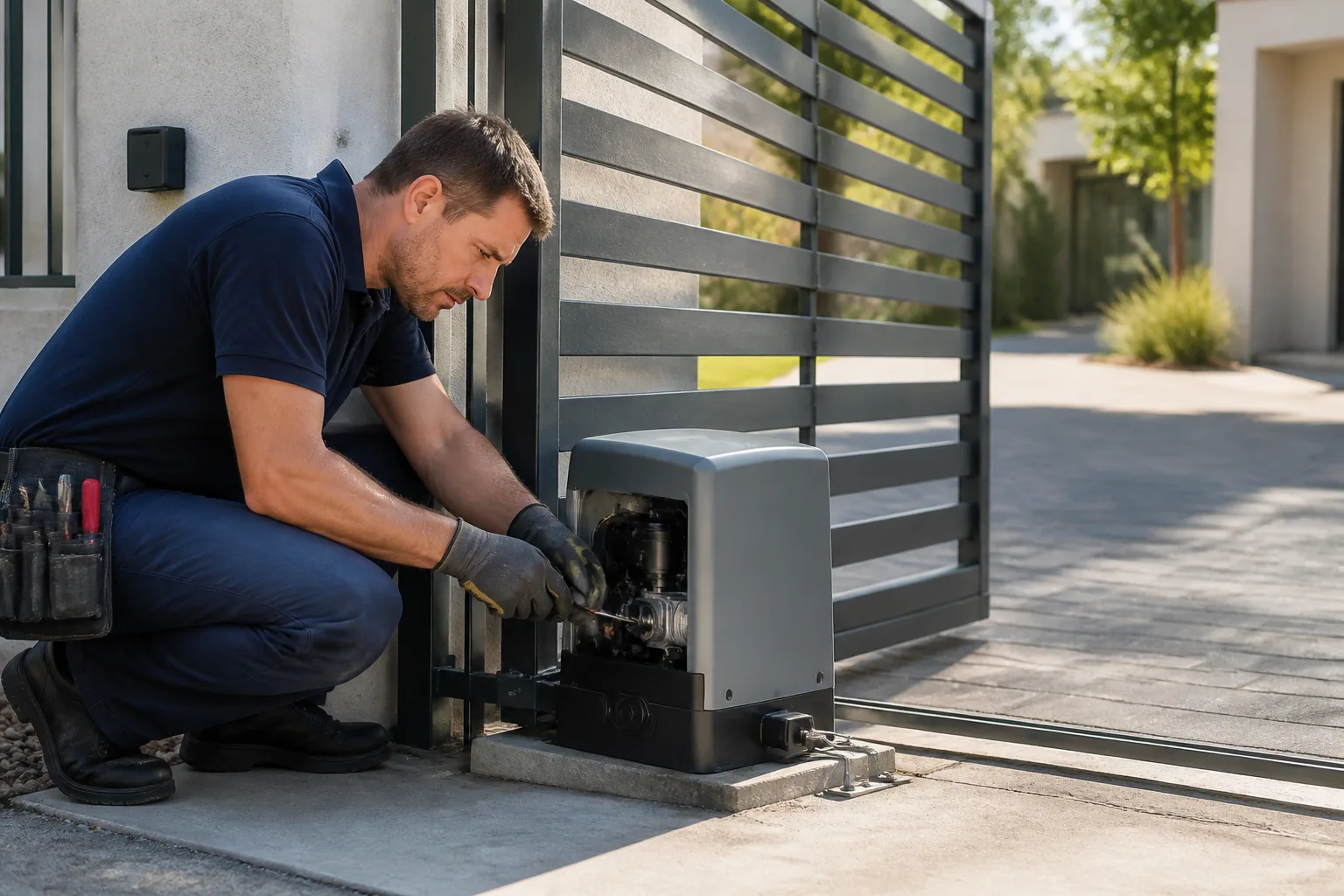
5 Mistakes to Avoid With Gate Motor & Opener
The most common gate motor failures we see in Los Angeles aren’t caused by defective parts. They’re caused by five preventable mistakes that compound quietly until the motor burns out or the gate stops mid-cycle. If you catch these early, you can add years to your opener’s life. If you’d rather have a gate-only specialist check it, call us at (833) 805-4890 for a free estimate.
Mistake 1: Running a Motor on a Gate That’s Out of Balance
This is the big one. A gate that’s even slightly out of balance puts about 15% extra load on the drive mechanism every single cycle. Over a year, that’s thousands of unnecessary strain events. The motor works harder, runs hotter, and the internal gears wear faster than the manufacturer ever intended.
Here’s how to check it yourself. Disconnect the motor arm and manually move the gate through its full travel. It should glide smoothly and stay put at any point along the track. If it drifts closed, hangs up at the midpoint, or takes real effort to push, you’ve got a balance problem. The drag test is simple: with the gate disconnected, it shouldn’t take more than about 15 pounds of pressure to get it moving, and once started, it should coast to a stop without binding.
In our experience across Los Angeles, we see this most often after fence repairs or hinge replacements where the gate was rehung without checking the center of gravity. We pulled one out of a garage over in Echo Park last month where a well-meaning fence contractor had moved the bottom hinge up two inches to clear a new paver edge. The gate now had a slight forward tilt, and the Viking operator was pulling 40% more amps than spec. The motor was six months old and already overheating.
Fix the gate first. Then tune the motor. Doing it in reverse order just burns through operators.
Mistake 2: Ignoring Force Settings After Any Gate Adjustment
Every automatic gate motor has force or sensitivity dials that tell it how hard to push before reversing on an obstruction. These aren’t set-and-forget. When anything changes, the force requirement changes too.
Common triggers we see in Los Angeles:
- New hinges or wheels that are tighter than the old ones
- Seasonal swelling on wood gates after rain
- Slight track settling that adds rolling resistance
- Adding decorative ironwork that changes gate weight
If the force setting is too low, the gate reverses on normal operation and you think the motor’s faulty. If it’s too high, the motor keeps pushing through resistance that should tell it something’s wrong. That overwork condition kills the drive system and creates a real safety hazard if the gate hits a person or vehicle without reversing.
After any gate adjustment, run the full open-close cycle and watch the motor housing temperature. Warm is normal. Hot enough that you can’t keep your hand on it for three seconds means the force is set too high or the gate still has mechanical drag. On brands like Linear and DoorKing, the force pots are under the control cover and clearly labeled. Adjust in quarter-turn increments, testing each time.
Mistake 3: Using Non-Spec Batteries in Backup Units
Many Los Angeles properties now have battery-backup gate operators for power outage access or fire code compliance. The battery isn’t just a power reservoir. It’s part of the control board’s voltage regulation circuit, and the board expects a specific internal resistance and discharge curve.
We’ve replaced three Ghost Controls boards this year in the San Fernando Valley alone where the owner had swapped in a generic 12V battery from an auto parts store. The voltage looked right on a multimeter, but the charging circuit couldn’t properly maintain the cell. Over six to eight months, voltage variance crept high enough to damage the logic board. No error code, no warning beep. Just a dead operator one morning.
Check your manual for the exact battery spec, including amp-hour rating and chemistry type. If you’ve already substituted a non-spec battery, replace it now and consider having the board tested. The cost of a proper battery is a fraction of a control board replacement.
Mistake 4: Letting Vegetation or Debris Contact the Gate During Travel
This sounds obvious until you realize how gradual the problem is. A shrub grows an inch closer to the gate track. A few leaves stick in the slide gate guide. A pebble wedges in the rack. Each adds a small, intermittent load that the motor compensates for automatically. You don’t notice the gate is working harder until the cumulative strain shows up as a failed gearbox or stripped drive belt.
Walk your gate’s full travel path monthly. Clear the track, check for overhanging branches, and look for debris buildup in the gate’s lowest position. For swing gates in particular, watch for root heave or ground settling that changes the gate’s arc. In hillside areas of Los Angeles like Laurel Canyon or the Hollywood Hills, we’ve seen gates that cleared perfectly at installation start brushing the driveway six months later after winter rains shift the footing.
The motor can’t tell you it’s struggling. It just keeps working until it can’t.
Mistake 5: Calling a Generalist for Brand-Specific Board Work
This is where we see the most expensive mistakes. A gate motor throws a fault code, or the remote stops working, or the gate starts opening on its own schedule. The property owner calls a handyman or a garage door company that “also does gates.” They diagnose a bad control board, source a replacement, and install it.
The problem: many modern gate operators, especially DoorKing and Elite systems, have firmware that’s matched to the board revision and the specific accessories connected. Install a board with newer firmware on a system with older photo eyes or keypads, and you get phantom faults, intermittent operation, or complete lockout. We’ve been called to jobs in West LA where the previous technician had flashed the wrong firmware version and bricked a $600 board trying to fix a $40 loop detector.
Gate-only specialists keep current on revision levels and factory bulletins. At Ironwood Gate Repair Los Angeles, David and his team work on nine major automation brands including Linear, Viking, Ghost Controls, and DoorKing, so we’re not guessing whether your system is supported. We diagnose and fix on-site, with the parts and programming capability to match the right board to your exact configuration.
When to call a pro: If your gate motor is running hot, throwing codes you can’t clear, or has had more than one “minor” repair in the past year, the underlying problem is probably mechanical or configurational. A motor replacement without fixing the root cause just starts the failure clock over.
Related services in Los Angeles: For motor replacement or upgrade, see our Gate Motor & Opener in Sacramento page for service details, or our Ironwood Gate Repair Los Angeles home page for full capabilities.
The Bottom Line
Gate motors are more durable than most people assume, but they’re not forgiving of neglect. The five mistakes above share one trait: they’re all preventable with attention to the mechanical system the motor is attached to. A balanced gate, properly set force limits, correct battery spec, clear travel path, and brand-knowledgeable repair work will keep most operators running well past their warranty period.
If you’re in Los Angeles and want a gate-only specialist to assess your motor’s condition, Ironwood Gate Repair Los Angeles offers free estimates. David Kaplan serves as Field Supervisor on every job, and we’ve got 14 years and 233 verified reviews backing the work. Call (833) 805-4890 or reach out through our site.
Key Takeaways
- Disconnect and manually test your gate’s balance quarterly; it should move smoothly with minimal pressure
- Recheck force settings after any hinge, wheel, or structural adjustment
- Use only manufacturer-specified batteries in backup systems
- Clear vegetation and debris from the full travel path monthly
- For board-level repairs, verify the technician has brand-specific training and current firmware knowledge
Frequently Asked Questions
A failing motor often hums without moving, runs briefly then trips its thermal cutoff, or requires multiple remote presses to respond. An overloaded motor typically runs but gets progressively hotter and noisier over weeks. Check the gate balance and force settings first. If those are correct and the motor still struggles, it’s likely internal wear. Call (833) 805-4890 for a free diagnostic in Los Angeles.
Sometimes, but rarely plug-and-play. Different brands use different mounting patterns, control voltages, and accessory protocols. We’ve retrofitted Linear operators onto old Mighty Mule mounts and adapted DoorKing systems to existing loops, but each requires bracket fabrication and reprogramming. For a proper match, we need to see the gate weight, cycle frequency, and existing access hardware. Call for an on-site assessment.
Most often the force setting is too low, or there’s mechanical resistance the motor interprets as an obstruction. Check for debris in the track, binding hinges, or recent changes to the gate weight. On photo-eye systems, misaligned or dirty sensors can also cause phantom reversal. Clean the lenses and verify alignment before adjusting force limits.
With proper installation and maintenance, a residential gate motor should last 10 to 15 years in Los Angeles conditions. Coastal properties in Marina del Rey or San Pedro may see shorter lifespans due to salt air corrosion on external components. Commercial gates with high cycle counts might need motor replacement in 7 to 10 years regardless of brand. The biggest variable isn’t the motor quality, it’s whether the gate itself stays properly balanced and maintained.
Written by David Kaplan, Owner / Field Supervisor at Ironwood Gate Repair Los Angeles, serving Los Angeles since 2012.
Need Gate Repair Help?
Call Ironwood Gate Repair Los Angeles — licensed & insured, here with fast after-hours help in Los Angeles.
(833) 805-4890