
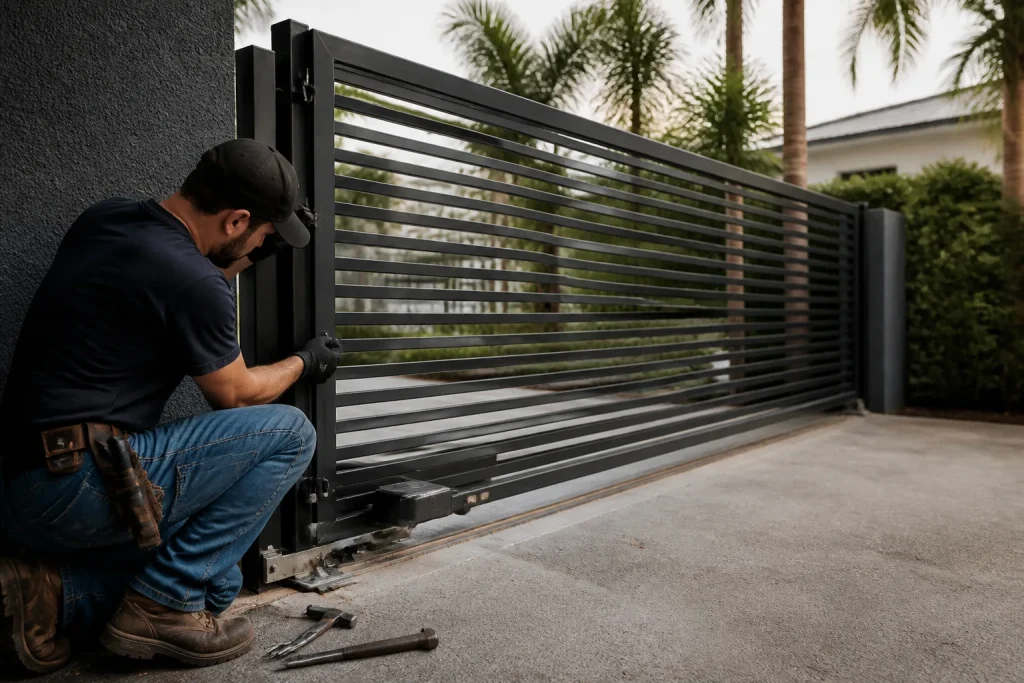
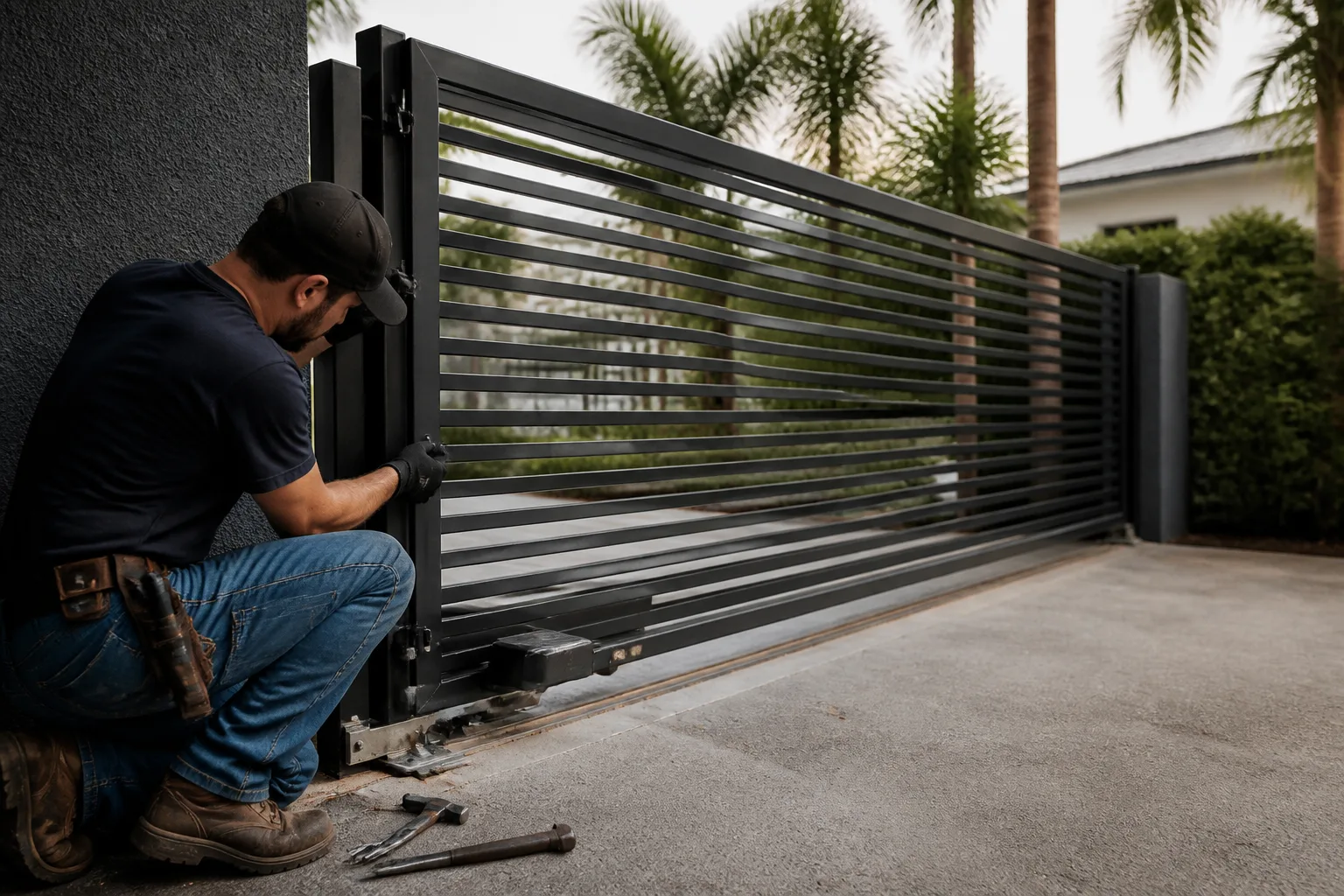
5 Mistakes to Avoid With Gate Repair
The most expensive gate repair mistakes in Los Angeles all stem from one misunderstanding: treating a gate like a simple mechanical device instead of an integrated system where electrical, structural, and software components interact. Fixing one layer without checking the others is why callbacks happen. If you’d rather not diagnose this yourself, call us at (833) 805-4890 for a free estimate.
Here’s the pattern we’ve seen across 14 years and 233 reviews in the Los Angeles area. The number-one callback isn’t a bad part — it’s a good part installed into an undiagnosed problem that was already there. Someone swaps a motor, the gate works for three months, then the new motor burns out because the underlying issue was never found. That scenario plays out in neighborhoods from Sherman Oaks to Silver Lake more often than it should.
Mistake 1: Replacing the Operator Without Testing Manual Swing Resistance
A gate operator doesn’t fail in a vacuum. When a motor dies, most people assume the motor was the problem. Often it’s the victim.
Before any operator replacement, we test how the gate moves by hand. A swinging gate should glide through its arc with minimal resistance. If it binds, drags, or needs two people to push, that mechanical load is what killed the previous motor. Installing a new LiftMaster or FAAC unit onto a binding gate is like putting a new engine in a car with seized brakes. The new motor works harder, draws more amperage, and burns out within months.
In Los Angeles, we see this constantly with hillside properties in the Hollywood Hills or Pacific Palisades, where gate posts shift subtly with winter rains and summer dryness. The gate still “works,” but it’s fighting gravity and geometry every cycle. We measure the actual force required to move the gate, check post plumb, and inspect hinge alignment before quoting any operator replacement. Skipping this step means buying the same repair twice.
What to check:
- Disconnect the operator and move the gate through its full range by hand
- Feel for catches, grinding, or points where the gate hangs
- Inspect hinge bolts for wallowing or elongation
- Check that posts haven’t shifted or settled
Mistake 2: Hiring a Handyman or Garage Door Company for Gate Automation
Gates and garage doors share a word — “door” — and not much else. The liability gap between a 400-pound swinging gate with entrapment risk and a sectional garage door moving vertically in a fixed track is enormous. Yet we regularly arrive at Los Angeles properties where a generalist has already attempted the repair.
Gate automation involves high-voltage electrical work, structural load calculations, and safety entrapment devices governed by UL 325 standards. A garage door technician may be excellent at torsion springs and photo eyes, but gate limit switches, loop detectors, and two-wire vs. three-wire magnetic lock configurations are a different discipline entirely. We’ve had to reverse handyman wiring jobs in Los Feliz where low-voltage control lines were run parallel to 110V power, inducing phantom signals that made the gate open randomly at 2 AM.
David and his team at Ironwood Gate Repair Los Angeles home work exclusively on gates. That focus matters when you’re diagnosing whether a BFT operator’s fault code indicates a motor issue, a control board problem, or a ground fault in the conduit run. A gate-only specialist has seen your specific failure pattern before. A generalist is learning on your property.
Mistake 3: Ignoring Limit Switch and Sensitivity Settings After Repair
This is where liability lives. After any gate repair — motor replacement, hinge adjustment, wheel replacement — the gate’s travel limits and obstacle sensitivity must be recalibrated to match the new mechanical reality. Skip this step, and the gate may not detect a person or vehicle in its path.
We’ve responded to calls in Mid-City where a gate that “was just fixed” struck a delivery van because the close limit was set too far, or failed to reverse on contact because the current-sensing sensitivity was dialed too high. In Los Angeles, where pedestrian traffic at residential gates is constant — dog walkers, food delivery, contractors — this isn’t theoretical.
Proper setup means testing with a solid object at multiple points in the gate’s arc, verifying the entrapment device functions, and documenting the settings. We do this on every job David Kaplan supervises in the field. It’s not a bonus step. It’s the step that keeps you out of court.
When to call a pro: If your gate doesn’t consistently reverse on contact, or if it closes with visibly different force than it opens, the safety settings need attention. This isn’t a homeowner adjustment — the interaction between mechanical resistance and electronic sensitivity requires test equipment and knowledge of your specific operator’s programming sequence.
Mistake 4: DIY Logic Board Resets That Mask Electrical Faults
Modern gate operators — Linear, Viking, DoorKing, and others — have diagnostic LEDs and fault codes that point to specific problems. The internet’s favorite fix is “unplug it, wait 30 seconds, plug it back in.” Sometimes that clears the fault. Often it masks a short or ground fault that will return, worse, usually at the most inconvenient time.
Here’s what actually happens. A ground fault develops in the low-voltage loop running under your Los Angeles driveway. The operator detects erratic current and throws a fault. You reset the board. The gate works for two weeks, then the fault returns. Each reset degrades the logic board’s protection circuitry slightly. Eventually the board fails completely, or worse, the intermittent fault damages the motor windings.
We traced one such issue in the Valley last month where a homeowner had been resetting their operator for six months. The actual problem was a nick in the direct burial cable where a landscaping stake had pierced the insulation. Rainwater completed the circuit. The board was fried by the time we arrived, and the motor wasn’t far behind. A $200 cable repair became an $1,800 system replacement.
Electrical diagnostics require understanding what the fault code means, not just clearing it. Is it a legitimate obstruction? A failing edge sensor? A ground fault? A loose terminal building resistance? Each has a different repair path. Guessing wastes money and can create fire or shock hazards.
Mistake 5: Deferring Small Fixes Until They Become Structural Failures
This is the most preventable and most common mistake. A hinge bolt loosens slightly. A wheel develops flat spots. The gate still works, so it gets ignored. Eighteen months later, the gate has sagged, the track is worn, the operator is straining, and the repair bill has tripled.
In Los Angeles, our climate accelerates this cycle. Morning marine layer moisture corrodes hardware. Afternoon heat expands and contracts metals at different rates. Gates in beach-adjacent neighborhoods like Venice or Santa Monica see faster hardware degradation than inland properties.
We inspect for these compounding issues on every service call. A loose bolt is a five-minute fix. A gate that has sagged enough to drag the track is a half-day structural realignment, possibly with welding. Our in-house capability means we fabricate or repair hardware on the spot rather than ordering parts and returning. That speed difference often determines whether a small fix stays small.
Related services in Los Angeles: If your gate is showing signs of structural wear, our Gate Repair in Sacramento and Gate Installation in Sacramento pages detail our full diagnostic process. For motor-specific concerns, see Gate Motor & Opener in Sacramento.
The Bottom Line
The five mistakes above share a root cause: approaching gate repair as a single-point fix rather than a system diagnosis. A gate is electrical, mechanical, and structural. Addressing one layer while ignoring the others guarantees a callback, often with a higher bill than the original repair would have required.
After 14 years and 233 verified reviews in Los Angeles, our most satisfied customers are the ones who called early, when the symptom was small. The most expensive jobs are almost always the ones that were deferred, DIY-patched, or handled by a generalist who didn’t recognize the underlying problem.
Key takeaways:
- Test manual gate movement before blaming or replacing the operator
- Gate automation requires gate-specific expertise, not general handyman skills
- Always recalibrate safety settings after any mechanical repair
- Electrical faults need diagnosis, not just resets
- Small hardware issues compound into structural failures within 18 months
If you’re in Los Angeles and your gate is showing any of these warning signs, Ironwood Gate Repair Los Angeles offers free estimates. David Kaplan or a member of our team will diagnose the actual problem, not just the symptom. Call (833) 805-4890 or reach out through our site to schedule.
Frequently Asked Questions
Disconnect the operator and try moving the gate by hand. If it binds, drags, or feels heavy, the mechanical system is the likely culprit, not the motor. A motor working against excess load will overheat and fail prematurely. Call (833) 805-4890 for a free diagnostic — we’ll test both the mechanical and electrical systems before recommending any replacement.
We don’t recommend it. Gate entrapment sensitivity and limit switches must be calibrated with test equipment and verified against UL 325 safety standards. Incorrect settings can cause the gate to strike a person or vehicle without reversing, creating serious liability. This is included in every professional repair we complete in Los Angeles.
Intermittent operation usually indicates an electrical fault — loose connections, ground faults, or failing components that haven’t fully failed yet. Resetting the operator temporarily clears the symptom but allows the underlying damage to progress. We use systematic electrical testing to locate the actual fault rather than masking it.
In our Los Angeles experience, addressing a loose hinge or worn wheel during routine maintenance typically costs under $200. Waiting until the gate sags and damages the track, operator, and frame often runs $1,500 to $3,000. The 18-month deferral is where most expensive repairs originate. Call (833) 805-4890 for a free inspection — estimates are free, and catching issues early is always cheaper.
Written by David Kaplan, Owner / Field Supervisor at Ironwood Gate Repair Los Angeles, serving Los Angeles since 2012.
Need Gate Repair Help?
Call Ironwood Gate Repair Los Angeles — licensed & insured, here with fast after-hours help in Los Angeles.
(833) 805-4890