LiftMaster Gate Repair in Los Angeles: A Homeowner’s Guide
LiftMaster gate repair in Los Angeles typically costs $280–$650 for residential operators and $450–$1,200 for commercial systems, with most service calls completed same-day. The brand’s error-code diagnostics and myQ connectivity layer make troubleshooting more precise than older operators, but that same sophistication leads to more misdiagnosed calls than any other brand we see in the field. If your gate is stuck, flashing codes, or offline, call us at (833) 805-4890 for a free estimate and same-day diagnosis.
Here’s the thing about LiftMaster that most Los Angeles homeowners don’t realize until they’re staring at a blinking control board at 10 PM: these operators are engineered to fail visibly. A LiftMaster gate operator throwing error code 1-5 isn’t broken. It’s doing exactly what it was designed to do, detecting an entrapment risk, and clearing that code without understanding why it triggered is how people get seriously hurt. We’ve seen it. Over 14 years and 233 verified reviews, we’ve learned that the most expensive repair is often the one that didn’t need to happen because someone misread what the system was trying to say.
Why LiftMaster Errors Get Misdiagnosed More Than Other Brands
LiftMaster builds operators with layered safety logic that other brands simply don’t match. FAAC and BFT have their own diagnostic languages, but LiftMaster’s combination of physical sensors, force-profile memory, and software-based entrapment detection creates failure modes that look like motor death when they’re actually calibration drift.
In Los Angeles, we see this constantly with hillside properties in the Hollywood Hills or Pacific Palisades, where gate angles shift subtly with winter rains and summer dryness. The operator’s force sensor was trained on a gate that moved freely in March. By August, the track has a 3-degree bind, the motor draws 15% more current, and the board throws a code 1-1 (overload shutdown). A generalist sees “motor overload” and quotes a $900 motor replacement. David and his team see seasonal track binding, free the obstruction, recalibrate the force profile, and the original motor runs another six years.
The brands we work on daily — LiftMaster, FAAC, BFT, Linear, Viking, Ghost Controls, DoorKing, Elite, and Mighty Mule — each have these personality quirks. LiftMaster’s is over-communication disguised as failure. Learning to listen saves money.
Residential vs. Commercial LiftMaster Operators: Different Beasts
This distinction matters enormously for repair approach and parts sourcing, yet most Los Angeles gate companies gloss over it.
Residential LiftMaster operators — the CSW200, LA500, RSW12U series — run on 120V residential power, typically manage gates under 1,000 pounds, and use myQ as their primary connectivity layer. Their control boards store limited cycle history and rely on simpler magnetic limit switches. Repair focus: sensor alignment, force calibration, myQ pairing failures, and worn worm gears in the gearbox.
Commercial operators — the HCT (High Cycle Technology) and VGC (Variable Gate Control) lines — are 230V beasts managing 15-foot industrial slide gates or 2,500-pound swing gates in apartment complexes from Koreatown to Van Nuys. They log thousands of cycles, communicate via hardwired loop detectors and telephone entry systems, and their entrapment protection uses dual-beam photo eyes plus edge sensors. Repair focus: loop detector tuning, fire-department integration, cycle-count maintenance scheduling, and gearbox rebuilds rather than replacement.
We’ve diagnosed commercial operators in Los Angeles that were “dead” because a property manager didn’t know the fire-department hold-open circuit had been triggered during a system test. The operator was fine. The input signal was locked. Understanding the difference between residential and commercial architecture prevents throwing parts at a signaling problem.
Reading Your LiftMaster Error Codes Correctly
Here’s what the most common codes actually indicate at the system level, not the generic “call a technician” response you’ll find elsewhere.
- Code 1-1 (Overload Shutdown): The motor drew excessive current for longer than the safety window. Could be a seized bearing, track obstruction, or — most commonly in Los Angeles — a gate leaf that has settled on its hinges and now drags. Check physical movement first before blaming the motor.
- Code 1-2 (Obstruction Detected): The entrapment sensor triggered during closing. Often a misaligned photo eye, but in our experience, also triggered by reflective glare off wet driveway concrete in morning sun, particularly on east-facing properties in Silver Lake or Echo Park. Clean lenses, check alignment, and if the pattern is time-of-day specific, consider eye relocation.
- Code 1-5 (Entrapment Protection Active): The force-profile system detected unexpected resistance. This is the code we opened with. The operator has learned what “normal” feels like, and something changed. Could be a new dent in the gate, a shifted post, or someone backing into the gate last Tuesday and not mentioning it. Resetting without finding the cause disables a safety system. Don’t.
- Code 2-1 (Limit Switch Fault): The operator doesn’t know where the gate is. On residential units, usually a failed or magnet-shifted limit switch. On commercial units, often a severed limit switch cable from landscape maintenance equipment.
- Code 3-1 (Control Board Communication Error): The board isn’t talking to the motor driver. Power surge from LADWP grid events in summer are a real cause here. We keep surge protectors in the truck for a reason.
These codes are in your manual, but the manual doesn’t tell you that Code 1-5 in July on a west-facing gate in the San Fernando Valley probably means thermal expansion in the aluminum track, while the same code in January after rain means debris in the roller path. Context matters.
myQ, Connectivity, and the Software vs. Hardware Confusion
LiftMaster’s myQ ecosystem is genuinely useful when it works, and genuinely maddening when it doesn’t. The failure point is almost never the operator itself.
Here’s what we’ve learned across hundreds of Los Angeles myQ service calls: the app “offline” status is usually a WiFi signal strength issue at the gate, not a myQ server problem or operator failure. Gates are metal. Metal blocks 2.4 GHz signals. If your router is inside a stucco house (which has its own wire mesh) and your gate is 40 feet away through a masonry pillar, your phone shows full bars because it’s outside, but the myQ hub is in a Faraday cage of your own construction.
Software issues we fix remotely or on-site: myQ account migration after Chamberlain’s 2023 security update, duplicate hub registrations, and geofencing conflicts with multiple family members’ phones. Hardware issues: failed myQ gateway modules, antenna damage from gardeners, and — once, memorably — a myQ hub that had been used as a chew toy by a determined German Shepherd in Los Feliz.
The diagnostic split is simple: if the physical remotes and keypad work but the app doesn’t, it’s connectivity/software. If nothing works, it’s hardware. We carry replacement myQ modules and can test signal strength on arrival.
Safety Reverse Systems and Why Amateur Adjustment Is a Liability
LiftMaster’s safety reverse and entrapment protection aren’t adjustable suggestions. They’re federally mandated under UL 325, and altering them without documentation exposes property owners to liability if someone gets injured.
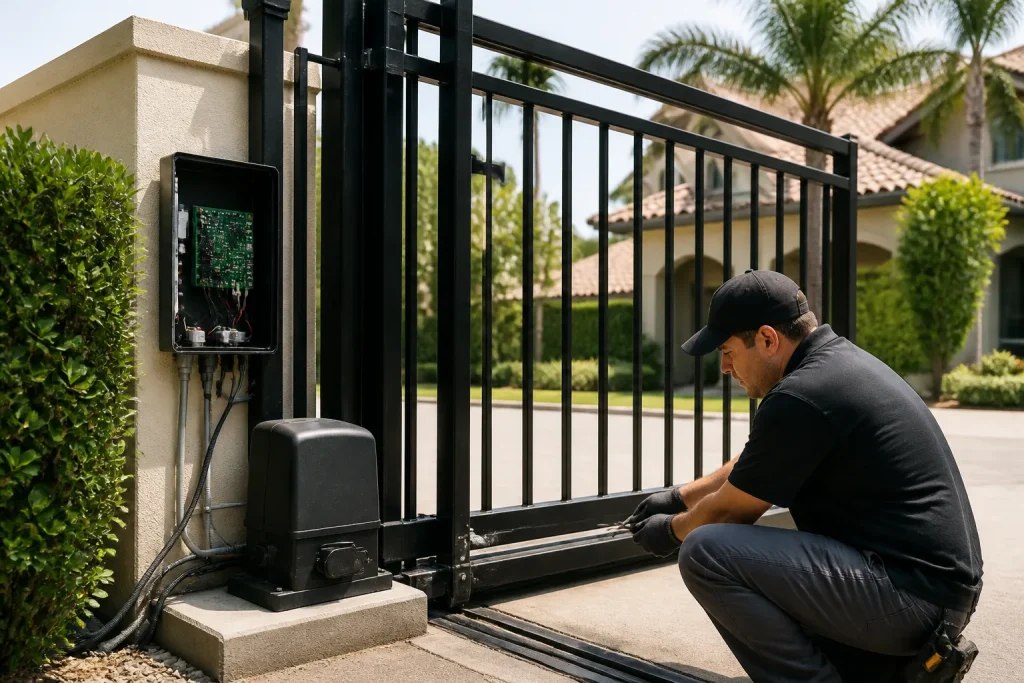
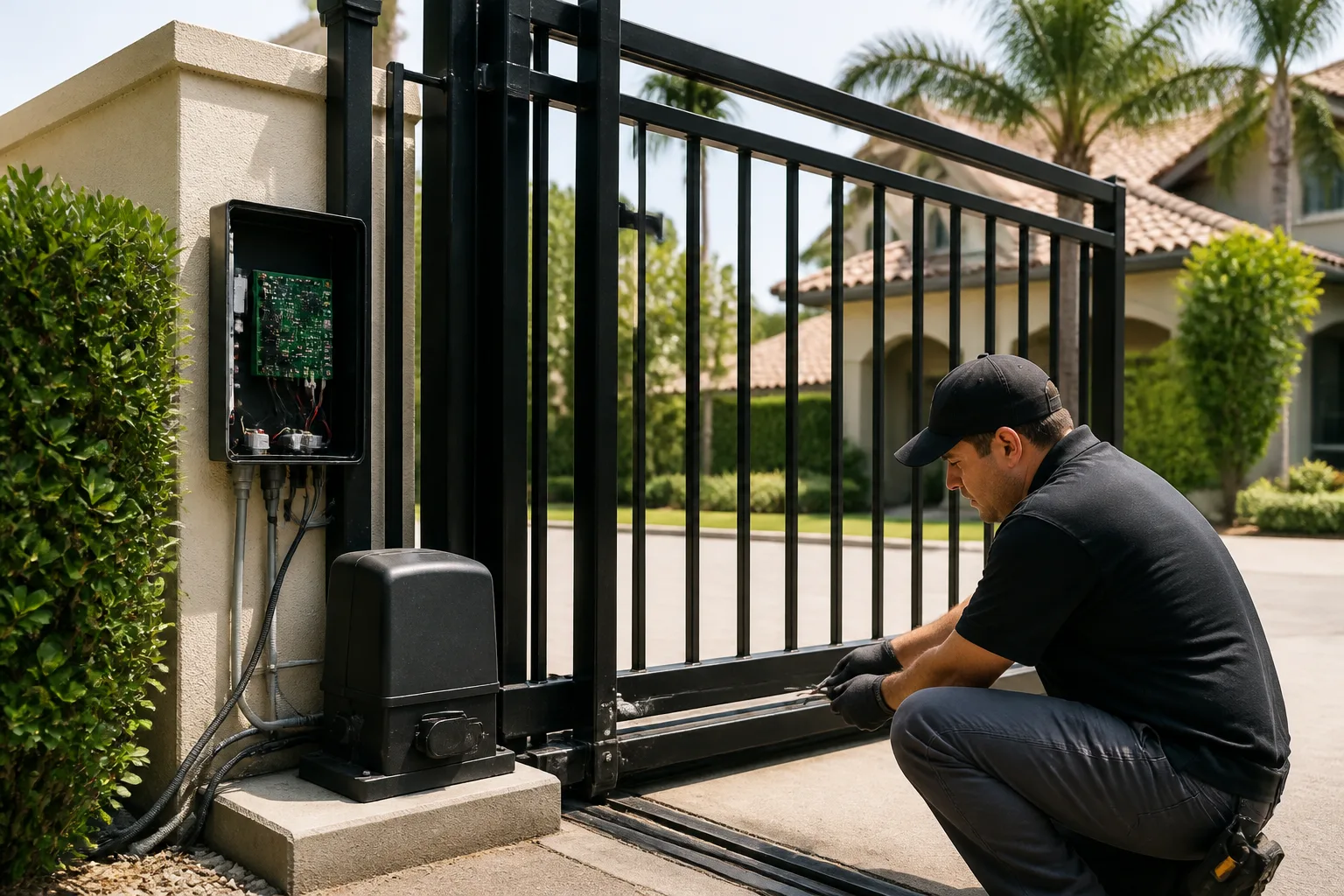
The system has two layers: the primary entrapment sensor (photo eyes or edge sensors) and the secondary force-limiting system that measures motor current draw. Both must function independently. When we test a gate in Los Angeles, we verify both with calibrated equipment, not a cardboard box and a guess. We document the force readings in pounds of pressure. If there’s ever an incident, that documentation exists.
False triggers happen. Photo eyes get knocked by landscapers. Edge sensors degrade in UV exposure (significant in Los Angeles). The force profile drifts as hinges wear. But “fixing” repeated triggers by increasing the force threshold or bypassing the photo eye isn’t repair. It’s negligence with a lawsuit attached. We’ve been called to properties where the previous “technician” had clipped the photo eye wires and told the owner the system would work fine. It did, until it didn’t.
When the safety systems on your LiftMaster operator are acting up, that’s not a DIY adjustment moment. That’s a call-a-specialist moment. The gate motor and opener systems we service include full safety verification as standard, not an upsell.
Authorized LiftMaster Parts vs. Aftermarket: What the Difference Actually Means
LiftMaster maintains an authorized parts chain through their dealer network. The components look identical to aftermarket alternatives on Amazon or eBay. They’re not.
Control boards from authorized channels carry firmware matched to specific operator revisions. An aftermarket board may boot and run, but it won’t have the correct force-profile curves for your specific model year, leading to premature safety triggers or insufficient entrapment sensitivity. Gearbox assemblies from authorized sources use the correct bronze alloy for the worm gear; aftermarket units we’ve replaced after 8-month failures used softer metal that shed teeth into the lubrication.
Our in-house parts capability means we stock authorized LiftMaster components for the models we see most in Los Angeles, and we fabricate hardware repairs on-site when the part is backordered. But we don’t substitute unauthorized electronics to get a job done faster. The system longevity cost isn’t worth it.
For property managers overseeing multiple Los Angeles locations, we maintain gate records by address, tracking which operators are installed, their install dates, and which components have been replaced. When the CSW200 at your Venice property needs the same gearbox we replaced in 2019, we know before we arrive.
When to Call a Pro for LiftMaster Gate Repair in Los Angeles
Call when error codes recur after reset, when the gate makes new noises, when safety triggers happen more than once, or when myQ stays offline after basic router reboots. Call before the small problem becomes an operator replacement.
Related services in Los Angeles: Gate Repair in Sacramento for structural and mechanical issues, Gate Installation in Sacramento for full replacement or new automation, and Gate Motor & Opener in Sacramento for motor-specific diagnostics and upgrades.
The Bottom Line
LiftMaster operators tell you what’s wrong if you know how to listen. The codes mean something specific. The connectivity issues have identifiable causes. The safety systems are protective, not defective, when they trigger. The most expensive mistake is replacing a motor that was trying to warn you about a $50 track adjustment.
After 14 years of gate-only work in Los Angeles, 233 verified reviews, and hands-on experience with every major automation brand, we’ve learned that the best repair is the one that answers why the failure happened, not just what failed. David Kaplan serves as Field Supervisor on every job, so the person with final accountability is the person who shows up.
If your LiftMaster gate is flashing codes, stuck mid-cycle, or offline in the myQ app, call Ironwood Gate Repair Los Angeles at (833) 805-4890. We’ll diagnose it properly, quote upfront, and fix it with the right parts. Estimates are free.
Frequently Asked Questions
Residential LiftMaster repair typically runs $280–$650, while commercial systems range $450–$1,200 depending on whether the issue is sensor alignment, control board replacement, or gearbox rebuild. Simple limit switch or photo eye adjustments fall at the lower end; myQ module replacement or motor rebuilds trend higher. Call (833) 805-4890 for an exact quote — estimates are free.
The entrapment protection system has detected unexpected resistance or lost its photo eye beam. Check for physical obstructions first, then clean and realign the photo eyes. If the problem persists, the force profile may need recalibration or the gate’s physical movement has changed due to hinge wear or track settling. Repeated reversals without identified cause warrant professional diagnosis — bypassing safety systems creates liability exposure.
Most residential calls are completed same-day, and we stock common LiftMaster control boards, gearboxes, and safety sensors for this reason. Commercial operators with specialized fire-department integration or hard-to-source components may require next-day parts pull. Call (833) 805-4890 with your model number and error code for availability — we’ll tell you honestly if same-day is realistic.
LiftMaster operators built after 2012 with solid-state control boards are typically worth repairing if the gearbox casting isn’t cracked and the motor windings test within spec. Pre-2010 units with relay-logic boards are harder to source parts for and lack modern safety features. We assess cycle count, physical condition, and your connectivity needs (myQ integration, for instance) before recommending either path. Repair when it makes sense, replace when it doesn’t — we don’t gain from selling you an operator you don’t need.
Written by David Kaplan, Owner / Field Supervisor at Ironwood Gate Repair Los Angeles, serving Los Angeles since 2012.
Need Gate Repair Help?
Call Ironwood Gate Repair Los Angeles — licensed & insured, here with fast after-hours help in Los Angeles.
(833) 805-4890